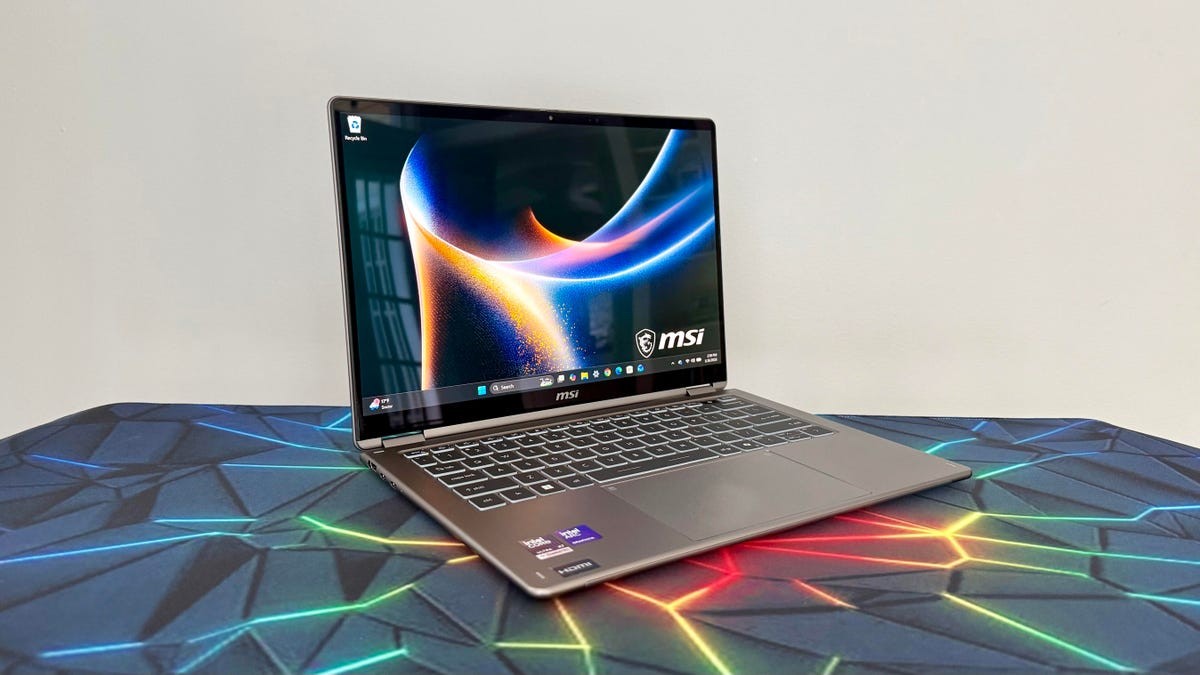
The MSI Prestige 14 Flip AI Plus marks a significant step forward in laptop technology, being among the first to feature Intel’s new Core Ultra Series 3 processor. This 14-inch two-in-one showcases the potential of Intel’s Panther Lake series, promising both improved performance and extended battery life. The integrated Arc B390 graphics processor is particularly noteworthy, delivering gaming and content creation capabilities typically reserved for laptops with dedicated GPUs. This raises a critical question: have integrated graphics finally reached a point where thin-and-light laptops can also offer a viable gaming experience?
While impressive, the Prestige 14 Flip AI Plus isn’t a gaming laptop in the traditional sense. It’s better described as an ultraportable device with surprising gaming capabilities. It achieves playable framerates in demanding AAA titles, even relying on Intel’s Xe Super Sampling Frame Generation in some cases to maintain smooth gameplay. Crucially, it maintains near-silent operation and all-day battery life – features rarely found in dedicated gaming machines.
MSI has redesigned the Prestige series to highlight these new internals, and the results are striking. Let’s break down what makes this laptop stand out.
Inside the Machine: Panther Lake Architecture
The Core Ultra X7 358H processor at the heart of this machine is manufactured on Intel’s advanced 18A (2-nanometer) process, featuring a 16-core configuration: four performance cores, eight efficient cores, and four low-power efficient cores. This core arrangement is similar to previous generations, but the 2nm process improves power efficiency. The Panther Lake architecture introduces RibbonFET transistors and PowerVia backside power delivery, further enhancing thermal management and performance.
Intel’s move to 2nm is a key differentiator. Apple’s M5 and Qualcomm’s Snapdragon X2 chips are still at 3nm, while AMD’s Zen 5 remains at 4nm. This process shrink directly translates to increased efficiency and reduced heat output.
The most significant upgrade is the integrated GPU: Intel’s Arc B390, featuring 12 Xe3 graphics cores – up from the eight Xe2 cores in previous generations. The new Xe3 architecture delivers greater performance and efficiency. AI performance also gets a boost, primarily from the GPU. The neural processing unit sees a modest increase to 50 TOPS, but the Arc B390 GPU jumps to 122 TOPS, significantly higher than the 64-74 TOPS found in previous generations.
Performance and Battery Life: A Rare Combination
The Prestige 14 Flip AI Plus, paired with 32GB of 8,533MHz DDR5 memory, delivers impressive performance and battery life. Geekbench 6 scores are excellent, trailing only Apple’s M5 MacBook Pro and Lenovo’s Yoga Pro 9i 16 Aura Edition. While it falls slightly behind in Cinebench 2024 compared to gaming laptops with RTX 4050 or 5050 graphics, it outperforms older Intel and Qualcomm Snapdragon X-series laptops.
However, the true strength lies in its efficiency. The Prestige 14 Flip AI Plus achieved over 25 hours of continuous YouTube streaming, rivaling Arm-based Snapdragon and Apple M-series chips. It lasted over two hours longer than the 14-inch M5 MacBook Pro in battery testing.
Gaming performance is also surprising. It’s the first laptop with integrated graphics to hit 60fps in Shadow of the Tomb Raider at 1080p with High settings. While it doesn’t match dedicated GPUs, it’s playable without compromising visual quality. In Guardians of the Galaxy, it averaged 53fps at 1080p High settings, nearly double the performance of comparable Arrow Lake laptops. Even in demanding titles like Assassin’s Creed Shadows, enabling XeSS Frame Generation pushes framerates to playable levels, though requiring Low settings for optimal smoothness.
The MSI Prestige 14 Flip AI Plus proves that it is possible to combine strong application performance, capable 3D gaming, and exceptional battery life in a single device – a combination previously unheard of.
Design and Build Quality: A Refined Aesthetic
The Prestige 14 Flip AI Plus introduces a completely redesigned look for MSI’s Prestige line. The laptop is impressively thin (half an inch) and lightweight (just over 3 pounds) with a rigid aluminum chassis. Rounded edges and a new MSI logo give it a more refined aesthetic, reminiscent of Lenovo’s Yoga 9i series.
The underside features a slot for the included MSI Nano Pen, cleverly housed between the rubber feet. While the pen is narrow, it’s convenient for quick notes. The 14-inch OLED display features a 1,920×1,200 resolution with a standard 60Hz refresh rate. Though a higher refresh rate would enhance gaming, the OLED panel delivers excellent contrast and near-perfect black levels.
The laptop includes quad speakers that produce fuller, more dynamic audio than typical thin-and-light models. It also boasts a generous port selection: two Thunderbolt 4 ports, two USB-A ports, and an HDMI connection. Biometric security features include a fingerprint reader on the power button and an IR sensor for facial recognition on the 1080p webcam.
The keyboard offers firm, shallow travel, similar to Apple’s MacBook Pro, but gamers may prefer more tactile feedback. The touchpad is roomy but standard in its mechanical click response.
Conclusion: A New Benchmark for Versatility
The MSI Prestige 14 Flip AI Plus stands out as a thin, light, well-designed laptop that delivers on Intel’s promise of “mobility without compromise.” Its combination of power, efficiency, and gaming capabilities is unprecedented. While not a replacement for dedicated gaming machines, it offers playable framerates in AAA titles alongside all-day battery life.
The Prestige 14 Flip AI Plus is the first Panther Lake laptop CNET has reviewed, but it sets a high bar. It’s a compelling choice for users who demand both performance and portability, marking a significant step forward in laptop technology.