Digital TV did not come out of nowhere. It evolved. To truly understand how digital television is changing the viewing experience, we must first look at the beast that has dominated American living rooms for half a century: analog television.
If you already know how a traditional TV works, you can skip the basics. But for others, the old system actually worked like this.
Building an analog signal
For about 50 years, American analog standards dominated television broadcasts. The process starts with the camera. Record the scene at 30 frames per second.
This camera scans the image. Divide the image into rows of individual dots. We call them pixels. Each pixel has a specific color and intensity value.
These lines don’t just float around aimlessly. Added to the sync signal. These are the Horizontal Sync pulse and the Vertical Sync pulse. Without these, the electronics inside the TV cannot correctly place the lines on the screen.
The result is a composite video signal. This single stream carries the color and intensity data for each pixel in the frame, along with the necessary synchronization cues.
Audio? Completely independent.
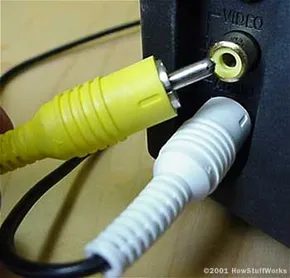
Remember the back of an old VCR? You will see a yellow plug. It is a composite video. The sound is handled by the white plug for mono and the red and white plug for stereo.
Define signals
Once you have a composite video signal and audio track, you can do a number of things with it.
It can be transmitted as radio waves. When you attach an antenna to your TV and listen to local channels for free, you receive analog TV.
You can save them. VCRs have been doing this for decades.
You can pump them through your cable system with hundreds of other composite signals.
Basically, much of the 20th century equipment was built to handle this particular form of signal.
Frequency band and modulation
When a TV station transmits this signal wirelessly, it transmits it on a specific frequency. In the US, these channels are mapped as VHF channels 2-13 and UHF channels 14-83.
The video part of the signal is sent as an AM signal (amplitude modulated). The audio part is FM (frequency modulation).
The FCC solves this problem by dividing the radio spectrum into specific frequency bands. They divided the spectrum into 6 MHz segments. These channels are located at:
- 54 to 88 MHz for channels 2 to 6
- 174 – 216 MHz (channels 7 – 13)
- 470-890 MHz for UHF channels 14-83
When a VCR plays back a tape, it not only plays back the original signal. It takes composite video and audio from tape and modulates it onto a carrier wave. Typically, channel 3 is 60 MHz and channel 4 is 66 MHz. It perfectly imitates the operation of a television.
Instead of network transmission, the VCR sends its signal directly to the TV via a coaxial cable. Cable TV receivers and satellite receivers work on the same principle.
Analog digital bridge
You’ve probably heard a lot about “digital satellite systems” and “digital cable systems.” This is the problem.
These set-top boxes receive digital signals from your service provider. However, it converts the signal back to analog form before sending it to the TV.
This is why service providers say that switching to digital television (DTV) in June 2009 will not force you to buy a new television. As long as your set-top box performs the conversion, your old analog TV will still work.
But it’s not real digital TV.
Real digital TV is something completely different. It includes:
- Digital cameras record much higher resolution than analog sensors
- Digital transmission Not only modulates the waveform, but also compresses the data
- Digital display technology renders pixels directly without complex conversions.
The difference in resolution is very noticeable. Clarity is out of this world. The next section explains how this higher resolution changes what you see.