


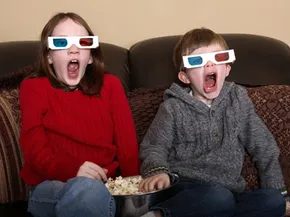
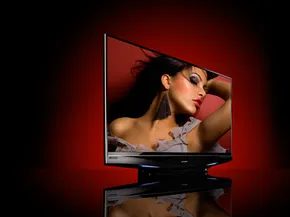
Television has undergone a radical transformation since it first flickered to life. We watched the shift from grainy black-and-white broadcasts to vibrant color screens. Manufacturers then chased larger formats, experimenting with projection methods that eventually gave way to the flat-panel revolution. For the last twenty years, LCD and plasma panels have shrunk from room-filling boxes into sleek slabs just a few centimeters thick. We now own 61-inch sets capable of rendering high-definition television (HDTV) so sharp, so vivid, that the individual pixels vanish. The image feels solid. Real.
But when a screen becomes large enough to replace a wall, where does innovation go next?
The answer might feel familiar because it’s old news dressed up in new glasses. We are talking about 3D television.
The Historical Cycle of 3D
This isn’t the first time the industry has tried to pull us into the third dimension. Audiences were first exposed to 3D technology in 1922 with the release of “The Power of Love.” Whether people at the time found it a novelty or a gimmick is lost to history, but it sparked a cyclical fascination that refuses to die.
The next major boom arrived in the 1950s. Studios were desperate to lure moviegoers away from their living room sets. They didn’t just rely on visuals; they relied on spectacle. B-movie producers introduced dozens of gimmicks to enhance the immersive experience. Some theaters installed vibrating plates in seats to simulate shocks. Others slid inflatable skeletons down zip lines during screenings. Compared to those chaotic stunts, wearing a pair of cardboard anaglyph glasses seemed tame by comparison.
3D in the Home Entertainment Market
Despite Hollywood’s long history with the format, 3D has struggled to make a significant dent in home entertainment. We’ve seen sporadic 3D television episodes and specials. There is a niche market for 3D DVDs. Yet, for most consumers, it remained a curiosity rather than a standard.
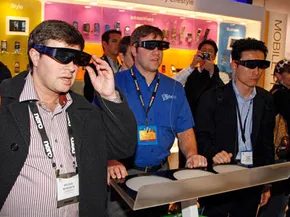
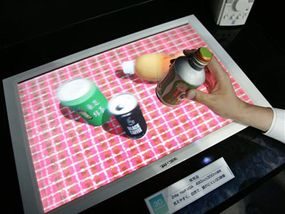
However, signs from the 2009 Consumer Electronics Show suggested a shift. The popularity of specific 3D exhibits indicated that manufacturers were serious about bringing this technology into the living room. The goal wasn’t just to show a movie; it was to create an illusion so convincing that viewers might reach out to touch the images on their screens.
Seeing in Three Dimensions

Why Flat Screens Look Flat (And How We Fix It)
You stare at an apple. It has volume. You can walk around it. Now, look at a photo of that apple on your monitor. It is a rectangle of pixels. The edges are sharp. The depth is gone. Why does your brain accept the real apple as a 3D object but rejects the digital version as flat?
It comes down to convergence.
When you look at something close, your eyes physically turn inward. The light rays entering each eye are no longer parallel. They cross. Your brain measures that crossing angle. It calculates the effort your eye muscles exerted. The brain uses this data to estimate distance. More convergence equals closer proximity.
A television screen breaks this loop. The screen is a fixed plane, usually six feet away. But a 3D movie tells your brain the object is floating two feet in front of the glass. Your eyes converge for the near object but focus on the distant screen. This mismatch is why 3D gives you a headache. It creates a sensory conflict. Your eyes are doing one thing. Your brain is sensing another.
Technology solves this by feeding each eye a slightly different image. But how do you separate those images so they don’t blur into a mess? You filter the light.
Passive Glasses and the Color Trick
In the commercial world, glasses fall into two buckets. Passive. Active.
Passive glasses are cheap. They rely on simple physics. You’ve probably used them. The classic example is the anaglyph.
Anaglyph comes from the Greek anáglyphos, meaning low relief sculpture. It projects slightly from the background. In film, it projects slightly into your face.
These glasses use colored lenses. Usually red and cyan. Or red and blue. Look at an anaglyph image without the glasses. You see two overlapping frames. One has a blue tint. The other has red. They are offset.
Put the glasses on. The red lens blocks the red light. It only lets the blue-tinted image through. The blue lens blocks the blue light. It only lets the red-tinted image through.
Your left eye sees one frame. Your right eye sees the other.
Your brain stitches them together. It creates a single image with depth. But remember that focus issue? Your eyes are still staring at the screen. They are converging on a point that doesn’t match the screen’s physical location. The illusion works. The strain remains.
Polarized Light: A Cleaner Experience
Anaglyphs are cheap but ugly. The colors are washed out. You lose detail. Movie theaters moved on. They use polarization.
Polarized glasses filter light waves based on their orientation. Light vibrates in all directions. A polarizing filter blocks all waves except those aligned with its axis.
The projector throws two images onto the screen. One is polarized horizontally. The other vertically. Or, in modern digital cinema, they use circular polarization. Left-circular and right-circular.
The glasses have corresponding filters.
The left lens only passes left-circular light. The right lens only passes right-circular light. Each eye sees only its assigned image. The colors stay true. The contrast stays high. It’s a better experience.
There is a catch. You can’t just buy polarized glasses for your living room TV. Most standard screens don’t project polarized light. You would need to coat the TV in a special film. Or replace the screen entirely. That is why polarization stays in theaters.
The Active Alternative
Passive glasses are convenient. But they have limits. The resolution is split. Each eye only gets half the picture.
Active glasses solve this by using batteries and shutters. They are heavier. They cost more. But they deliver a sharper image. They synchronize with the TV, closing the left lens while the right image displays, then switching.
We will look at how active glasses handle the synchronization in the next section. For now, just remember that the glasses are not magic. They are just light filters.
How Active Glasses Create Depth
Engineers stopped relying on colored plastic lenses years ago. The new standard uses active glasses to deliver a cleaner, sharper 3-D experience. Unlike anaglyph glasses, which wash out colors, these use liquid crystal display (LCD) technology to manipulate light. They don’t need polarization films on the screen either. Instead, they control exactly when each eye sees the display.
The glasses are not passive props. They have infrared (IR) sensors that sync wirelessly with your TV. The display alternates between two slightly offset images at an incredibly fast rate. If you look at the screen without the glasses, you see a blurry mess of two images superimposed on each other.
The LCD lenses in the glasses flip between transparent and opaque in perfect sync. When the right-eye image is on screen, the left lens blacks out. It reverses instantly for the left-eye image. The flicker happens too fast for your brain to notice. Your mind merges the two separate views into a single 3-D image.
Why Refresh Rates Matter
Old LCD and plasma screens struggled with this method. Their refresh rates were too slow. If the TV couldn’t update the image quickly enough, viewers would see the glasses flickering. It broke the illusion.
Modern displays have solved this. Manufacturers now produce panels with incredibly fast refresh rates. This speed is essential. It ensures the alternating images cycle smoothly without visible stuttering.
3-D Ready Televisions
High definition plays a major role here. It is easier to project 3-D in HD using active glasses than passive ones. A passive system forces the TV to display two full images simultaneously. That doubles the data load on the panel at any given moment.
An active glasses system alternates the images rapidly. This means the TV only needs to handle one image set at a time. The bandwidth requirement is lower. The result is a clearer picture with less strain on the hardware.
Not every TV qualifies. You need specific hardware to make this work. The next section breaks down exactly which models and features make a television truly 3-D ready.
Active 3D glasses don’t work with just any TV. You can’t plug them in and expect magic. The core problem is synchronization. The screen flips between left-eye and right-eye images rapidly. The lenses in your glasses must open and close in perfect lockstep with those flips. If they’re out of sync, you get double vision or nothing at all. This is where the stereoscopic sync signal connector becomes non-negotiable.
Most 3D-ready TVs and monitors include a specialized port for this exact purpose. It’s a standardized three-pin connector. You plug one end into the TV. The other end connects to an infrared (IR) emitter. This small device sits on top of your screen and blasts timing signals to your glasses. It’s the bridge between the digital video stream and the physical shuttering of your lenses.
How the Sync Signal Works
The connector relies on transistor-transistor logic (TTL). It’s a simple, robust electrical standard. One pin carries low-voltage power. Another is ground. The third pin carries the actual stereo sync pulse. That pulse tells the glasses when to switch.
But here’s the catch: not all active glasses are created equal. There are two dominant styles from the early 3D era: E-D and ELSA. They look similar. They cost similar amounts. But they are incompatible.
The stereoscopic sync signal standard works with emitters for both styles. However, the glasses themselves are picky. An E-D emitter will only drive E-D glasses correctly. An ELSA emitter might trigger the glasses, but the timing will be inverted.
Think about what happens if you mix them. The E-D emitter sends a signal saying, “Left lens, open.” The ELSA glasses interpret that same signal as, “Left lens, close.” The right lens opens instead. You get the opposite image for each eye. It’s worse than useless. It’s nauseating.
Why Your Content Won’t Look 3D (Yet)
You have the TV. You have the emitter. You have the glasses. You press play. And… flatness.
This is where content providers come in. A 3D-ready TV can’t create depth out of thin air. The video source must be optimized for stereoscopic viewing. Some studios shoot natively in 3D. They use dual lenses or specialized rigs. The footage is ready to go.
Others try to convert existing footage. Post-production teams can add depth maps and shift layers. It’s labor-intensive. And it often looks artificial. Many providers prefer to build 3D into the production pipeline from day one.
Right now, the most reliable way to watch 3D content is via a computer. Connect your PC to your 3D-ready TV with an HDMI cable. Stream the video from your computer. The PC handles the encoding and signal generation. The TV just displays it. It’s clunky. But it works.
Future hardware might change this. We’ll likely see DVD players and Blu-ray discs that send native 3D signals directly to TVs. Cable and satellite providers may even incorporate 3D broadcasts into their offerings. But until then, you’re stuck with the workaround.
Lenticular Displays
While active glasses dominate the home theater conversation, lenticular displays offer a different path. These screens use

Let’s be honest. While holographic tech captures the imagination, the reality of consumer 3D is messy. You can try lasers or projected mist, but those methods are either too niche or just impractical for the living room. They don’t scale. They don’t integrate. They fail.
But there is one method you have actually seen, even if you didn’t realize it. You’ve seen it at a football stadium. You’ve seen it at a corporate gala. It relies on a screen coated with lenticular film. This is the closest we have come to true, glasses-free 3D for mass audiences.
How Lenticular Displays Work
The secret lies in lenticules. These are microscopic lenses embedded on the base side of a special film covering the screen. The display doesn’t show one image. It shows two sets of the same image, interlaced together.
Here is the physics. The lenses direct light from the screen to your eyes. One lens focuses on the left eye’s image. Another focuses on the right eye’s image. Your brain receives these two distinct perspectives. It synthesizes them. You see depth.
It’s a optical trick, but a clever one.
Content creators have to do the heavy lifting here. They must create special interlaced files. If you were to look at this feed on a standard LCD, you wouldn’t see 3D. You would see a blurry mess of double images. The system is fragile. It requires precision.
The Sweet Spot Problem
There is a catch. A big one. Lenticular displays depend on a “sweet spot.”
You must stand in a specific position to get the effect. Move left. The image blurs. Move right. It distorts. Step into the next sweet spot, and the cohesive image snaps back into place. It’s like walking through a maze of light.
Manufacturers know this is a limitation. Some are testing cameras that track your head position. The TV adjusts the image in real-time to keep you in the sweet spot. It’s promising. But what happens when you have four people watching? The tech struggles with multiple viewers. For now, it’s a solo experience.
The Motion Sickness Factor
Even if you get the position right, your eyes might rebel. Some users report motion sickness after just a few minutes. Why?
It’s the conflict between focus and convergence. Your eyes focus on the flat screen. But your brain tries to converge on a 3D object that isn’t there. That mismatch causes strain. It’s uncomfortable.
On the flip side, you don’t have to buy active shutter glasses. You don’t have to charge batteries. You don’t have to worry about losing a $200 pair of plastic frames. There is an appeal to that simplicity.
Is 3D TV a Fad or the Future?
Will 3D become the next standard? Or is it a cyclical trend, fading in and out every few decades like CRTs or plasma screens? It’s too early to call.
The technology is improving. Faster processors. Better lenses. Smarter tracking. It may not be long before you instinctively duck when a baseball player hits a line drive toward the camera. Or maybe we’ll just accept that 3D is a party trick, not a daily driver.
The hardware is ready. The content is tricky. The audience is skeptical. We are waiting to see which side wins.


