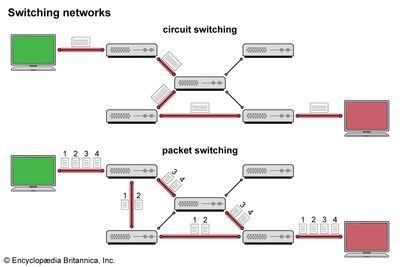
You send an email. You stream a video. You load this page. None of that happens through a single, dedicated wire held open just for you. That’s a myth. The internet runs on chaos. It runs on packet-switched networks.
These are digital systems that take your data files and shred them into tiny units called packets. They shoot these packets through a maze of nodes, or switches, across the globe. The switches use a method called store-and-forward. They grab the packet, look at the address, and send it on its way. At the destination, the computer reassembles the fragments into the original file. Without this process, the modern internet as we know it wouldn’t exist.
Most local area networks (LANs) use this same logic. If you’re on Wi-Fi or Ethernet, you’re riding packet-switched waves.
The Difference Between Circuit and Packet Switching
Traditional networks were different. Think of old telephone lines. Circuit-switched networks build a physical path with fixed bandwidth. They hold that path open from start to finish. All data travels sequentially down that single track. It’s orderly. It’s rigid.
Packet-switched networks don’t care about order. They direct packets down multiple paths simultaneously. Each switch makes a decision based on efficiency. If one path goes down due to an outage, the switches reroute the packets along other available routes.
This creates a problem. Packets arrive out of order. They arrive at different times. The receiving end has to put the puzzle together.
This approach offers significant benefits over circuit switching. It optimizes channel capacity. It improves fault tolerance. If one road is closed, the traffic flows elsewhere. But there’s a cost. Packet switching is complicated. It demands significant processing power. It requires large amounts of random-access memory (RAM) in the switches.
There are also delays. Rerouting takes time. Sometimes, packets get lost in the shuffle. Because of these overheads, packet switching is preferred for relatively small files. Circuit switching is still used for larger transfers where timing is critical, like real-time video calls.
Anatomy of a Packet-Switched Network
Every packet-switched network has two main components. The core and the edge.
The core consists of routers and control systems. They are connected by high-bandwidth communication channels. This is the highway. The edge is where end-user systems live. Your laptop. Your phone. These hosts are capable of sending and receiving data packets.
Communication across the core relies on protocols. These are procedures that senders and receivers use to talk to each other effectively. The protocols used to transfer your data form a protocol stack.
Each transmission packet, often called a datagram, has two parts. The header and the payload.
The header contains control information. It holds the sender’s address. It holds the receiver’s address. It tells the switches where to go. The payload is the actual information you want to deliver. Sometimes, packets are split into even smaller units. This is called packet fragmentation.
Connectionless vs. Connection-Oriented Networks
Packet-switched networks come in two flavors. Connectionless and connection-oriented.
Connectionless networks, also known as datagram networks, work as described above. Data is partitioned into smaller pieces. Headers are attached. The datagrams take the best possible route from source to destination. There is no prior agreement.
Connection-oriented networks mimic circuit-switched networks. They set up a dedicated route between the sending host and the receiving host before any packet transfer occurs. This setup phase gains the benefits of circuit-switching while staying on a digital network.
Who Invented It?
The idea to break large data units into smaller packets didn’t appear fully formed. It evolved.
Paul Baran, an engineer at the RAND Corporation, first imagined the concept. He was answering a U.S. Air Force question. How could a computer communications network survive a nuclear attack? His solution was “hot-potato routing.” He published his theory in RAND studies between 1960 and 1962. He expanded it into an 11-volume analysis titled On Distributed Communications in August 1964.
The government and private corporations ignored him. The idea garnered little interest at the time.
Independently, Donald Davies, a computer scientist at the United Kingdom’s National Physical Laboratory (NPL), developed the same concept. He started working on a network to test it. Baran called his units “message blocks.” Davies called them “packets.”
The term stuck. Lawrence (Larry) Roberts, a manager at ARPA (now DARPA), learned of Davies’s work in October 1967. He saw a symposium in Gatlinburg, Tennessee. Roberts adopted Davies’s term packet switching for ARPANET. That project became the precursor to the internet.
It wasn’t smooth. It wasn’t immediate. But it worked. And now, every time you refresh a page, you’re witnessing the result of a decision made to survive a nuclear war. Or maybe just to send an email faster. The distinction doesn’t matter anymore. The packets are flying.
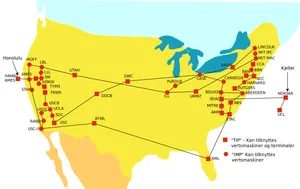
The groundwork for the modern internet was laid long before you ever clicked a link. It started with ARPANET, the first public packet-switched network, which ran its first successful test in October 1969. The design was tight—built in just one year by Bolt Beranek and Newman (BBN). They took concepts from Baran and Davies and made them real. At first, it was small. Four nodes. UCLA, Stanford Research Institute, UC Santa Barbara, and the University of Utah. By 1975, it grew to 57 nodes.
But the real story isn’t just the code. It’s the friction. When ARPANET was showcased in October 1972 at the first International Conference on Computer Communications (ICCC), the industry reaction was mixed. Yes, it proved packet switching worked. But much of the communications sector in the US remained uninterested. Some were outright hostile.
BBN and Roberts saw the gap. They founded Telenet that same year. A commercial network. Because the public sector wasn’t moving fast enough.
Global Skepticism and Parallel Builds
While the US hesitated, other countries moved. Or so it seemed.
In November 1973, France announced TRANSPAC. A domestic packet network run by the postal and telecommunications division. Then came DATAPAC in October 1974. The Trans-Canada Telephone System rolled it out. Japan’s Nippon Telegraph and Telephone Corporation planned their own public packet-switched data network.
Most providers stayed on the sidelines. They preferred to wait. Watch the early public networks perform. See if they actually worked in the wild.
“Most providers remained skeptical, preferring to wait and see how the early public networks performed.”
Experimental Networks Shaping Europe
During this waiting period, researchers didn’t stop working. They built new networks. They experimented. They improved on the core concept.
Donald Davies finished his Mark I network at the NPL in 1970. Then he built Mark II. Completed in 1973. It gradually influenced the UK and much of Europe.
Louis Pouzin, a French computer scientist, finished CYCLADES in that same year. 1973. This one was different. It was datagram-based. It shifted responsibility. Instead of network cores handling errors, the hosts did. This changed computer communications forever.
The European Informatics Network (EIN) came online in 1976. Funded internationally. Another piece of the puzzle.
The Push for Standardization
Why did nations need to talk? Five countries were building public packet networks. Canada. France. Japan. The UK. The US.
They needed a standard host-network interface. Strong motivation. Without it, their networks were islands. Talks began in 1975. The result was CCITT Recommendation X.25. Adopted by all involved nations in March 1976.
X.25 ushered in the next phase. Interconnected public service networks. It wasn’t the end of the story. Additional agreements followed. X.75 was a standard protocol for connecting international networks. It allowed different countries’ infrastructures to talk to each other.
The DoD Split and TCP/IP
By 1979, Robert Kahn became director of the Information Processing Techniques Office (IPTO) at DARPA. The US Department of Defense had multiple packet-switched networks. But none were compatible. They spoke different languages.
Kahn fixed it. He had the DoD adopt TCP/IP. A protocol standard he first imagined in a 1974 paper written with Vincent Cerf. Prominent software developer. Co-author.
TCP/IP spread. It moved to other research labs. Then to the public at large. It became the basis for the ultimate packet-switched network. The Internet.
The transition wasn’t instant. But the architecture held. The standards stuck. And the skepticism of the 70s faded into the infrastructure of today. We still use the same fundamental logic. Packets moving. Hosts correcting. Interfaces defined.