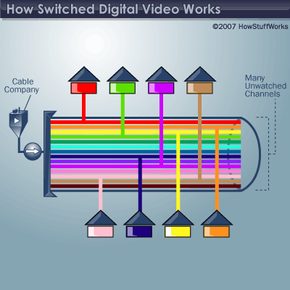
Cable companies are hitting a wall. Or rather their wires are.
Consumer demand for bandwidth is growing explosively. We are now approaching the physical limits of our network infrastructure, and in some areas we have already exceeded them. Today’s cable television providers offer more than just television programming. They offer digital video, audio channels, high-definition (HD) streaming, video-on-demand (VOD), high-speed cable modem Internet, and digital phone services.
Coaxial and fiber optic cables have high capacity. However, the capacity is not unlimited. If too many clients access data at the same time, the system can become clogged. The quality of the service has deteriorated. Lag spikes. The buffer wheel spins.
To solve this problem without having to look everywhere for new fiber, companies are adopting one particular solution: switched digital video. This is a technical term for a simple concept. “Stop sending everything to everyone all the time.”
The Old Way: Broadcasting Everything to Everyone
To understand why this is important, you need to understand how traditional wired systems work. It is an ineffective creature.
In a traditional setup, the cable terminal broadcasts each channel as a continuous, uncompressed stream across the network. Send a signal to every neighborhood, every street, every building. Always. Even if you don’t watch anything. Even if you are sleeping.
Set-top box (STB) works as a filter. scans that massive, constant stream to find the frequency of the selected channel. It separates the signal and sends it to the TV.
This approach works well if you have enough bandwidth. It won’t work very well if everyone is watching 4K sports, streaming Netflix or downloading large files at 8pm.
The problem is the overhead. Since the network transmits all channels 24/7, there is little free bandwidth available for Internet and interactive services. The HD channel is to blame. Consumes much more data than standard resolution. The demand for high-definition content is growing rapidly as households replace older televisions with high-definition televisions. Cable companies are scrambling to add dozens of high-definition channels to compete with satellite providers, further clogging the pipeline.
The Switched Digital Video Solution
Switched digital video flips the model. We no longer treat bandwidth as a park where everyone can throw their trash. It treats it like a private road where traffic is managed.
The network continuously broadcasts only the most popular channels, not one large stream containing all possible channels. Think of the top 20 channels that 80% of viewers in the area are likely to watch. They remain on the “main roads” of the network.
When you tune to a niche channel like a local arts station, a foreign language network or a obscure documentary channel and the system will respond. It detects your set-top box’s request. It then “switches” the signal from a specific channel to a specific network segment in your home.
It is on-demand infrastructure for linear TV.
Service providers only broadcast channels that customers really want to watch.
This distinction is very important. Networks can free up a lot of bandwidth by not broadcasting the 500th channel to the 500th household that doesn’t watch it. The released capacity does not just sit idle. It can be repurposed.
Why this matters for internet speed
The spare bandwidth generated by switched digital video is more than just a technological gain. It is a business enabler. According to IneoQuest, the company implementing these solutions, the efficiency gains allow cable providers to:
- Expand HD offerings: Add more HD channels without degrading the performance of your existing network.
- Customize local lineups: Offer niche programming that appeals to specific demographics in different regions.
- Grow Video On Demand: Create even more VOD libraries to give users a more detailed list to choose from.
- Enable interactive TV: Experiment with formats that require two-way communication.
- Targeted advertising: Show specific ads to specific markets or individual households based on viewing habits.
- Boost internet speeds: This is the big one. By reducing network congestion, cable modem customers can download content at significantly higher rates
The logic is simple. Less video loss means more data space. As HD becomes the norm rather than the exception, this efficiency becomes a necessity.
We are looking at changes in infrastructure management. The architecture of Exchange Digital Video technology is based on special devices in the front end and in the field to monitor demand and exchange signals dynamically. This is more than just software. It’s about a complete rethinking of the last mile.
The following sections detail the hardware involved, the potential pitfalls of this approach, and which markets have already made the switch. The technology exists. The question is whether the cable industry can react quickly enough before the spectrum shortage becomes a crisis.
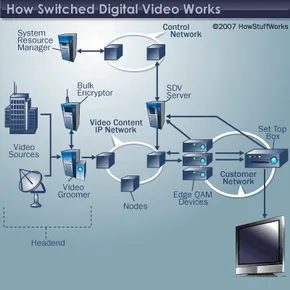
There is no general blueprint for building a switched digital video (SDV) system. All networks look different on paper. However, each setting is divided into four different levels due to their own quirks. You have the headend, a transportation system, an access system and a customer network. If you do these things right, your cable TV service will run smoothly. Get them wrong and you end up with a slow, frustrating mess.
Let’s look at where it all begins.
The Headend: Where Signals Are Born
The headend is the source. This is where raw video and internet feeds enter the digital ecosystem. This is a dense array of hardware connected directly to the cable operator’s infrastructure.
First, you need MPEG encoders. It takes a raw analog or digital signal and compresses it into MPEG format. Without this, you’re sending too much data.
Next is security. A bulk encryptor encrypts the signal. This ensures that only the correct set-top box (STB) can unscramble it. No encryption means there is no business model for pay TV.
Then there are the servers. Internet servers handle broadband traffic that customers can browse through a cable modem. The application server does the heavy lifting. This includes the Session and Resource Manager (SRM). SRM determines the bandwidth each application receives. It’s the traffic cop. A separate server monitors the status of all other components. SDV systems are complex beasts. It requires a particularly powerful machine to keeping configuration stable.
For some elements, communication is two-way. The video feed flows one way into the system. However, application servers interact with the network. They need to know everything is running smoothly.
The Transport System: Routing the Feed
When the headend encodes and encrypts the video, it pushes the signal into the transport system. The goal here is simple. It’s about move the feed from the headend to the access system.
This layer depends on nodes and routers. Nodes are intersection and branching points of cable connections. Routers direct traffic. They redistribute the signal to other nodes and routers. The path must cover the entire customer base. If the transmission system fails, the signal dies before it ever reaches the customer’s eyes.
The Access System: The Digital Switchboard
This is where the actual digital switching happens. The core component here is the SDV Server.
The SDV server keeps track of every channel change request. It is a specialized computer that uses special software to interpret these demands. When you click a button on your remote, the SDV server is listening.
It doesn’t act alone. Sends commands to the Edge Resource Manager (ERM) and multiple Edge QAM devices. ERM manages resources and QAM modulates signals for transmission. This coordination is what makes SDV efficient. Instead of sending every channel all the time, the system sends the ones being watched.
The Customer Network and QAM Basics
The last part is the customer network. This includes a set-top box that receives and decrypts the signal from the access system. A cable modem is also included if the customer subscribes to internet. Every company uses different interfaces between their customer networks and their access systems. Proprietary standards create lock-in, but also enable custom optimization.
To understand efficiency you need to understand QAM. It stands for quadrature amplitude modulation. This is a frequency division multiplexing technique. QAM allows cable companies to transmit digital signals more efficiently. Send multiple signals on the same line using 90 degree phase modulation. More signals. Same wire. This is a triumph of technology.
Headend preparation content. Traffic moves it. Access and switch systems. The customer network receives it. Each layer depends on other layers. If you break one, the whole chain collapses.
Next, let’s look at the pros and cons of this architecture. Is the complexity worth the bandwidth savings? This is a question that every service provider must answer.
Why bandwidth is the best currency
Cable companies are currently playing musical chairs with bandwidth, and the music is slowing down. The introduction of HDTV, high-speed cable modems, and video-on-demand (VOD) created demands that could cripple the entire system. Switched Digital Video (SDV) provides a lifeline. It’s not a silver bullet, but it’s a practical solution that allows service providers to squeeze more resources out of their current infrastructure without having to run miles of coaxial cable.
The core mechanism is simple. Traditional cable TV broadcasts all the channels to your home at the same time, whether you watch them or not. SDV will change that. It sends only the channels that viewers have actually requested. This selective transmission frees up a lot of bandwidth. For cable operators, this is a way to deal with the lack of bandwidth. For consumers, this means the system won’t crash when everyone nearby is watching a 4K movie at the same time.
More channels, faster internet and compromises
The additional space created by SDV can be used in two main ways. First, service providers can add channels. This is a direct attack on satellite TV providers. Cable companies can retain potential subscribers by offering high-quality sources and hyperlocal programming.
Another, and perhaps more directly related to everyday technological life, is the speed of the Internet. Cable Internet works by dividing the bandwidth into downstream and upstream parts. Downstream data (the data you download) uses a 6 megahertz (MHz) channel. Upstream data (what you upload) is compressed into a smaller 2 MHz channel. When a network becomes congested, service providers often create new downstream channels to handle the load. SDV frees up raw capacity and gives you more room to expand these downstream channels during peak times. You get faster downloads because the pipes are wider.
SDV systems offer options that are more important to the bottom line of cable companies than to the viewing experience of consumers.
Data perspective
Here the advantage shifts from technology to business. SDV provides cable companies with detailed information about your viewing habits. Although they claim to protect personal privacy, they can still see which channels are trending in a particular area. This information is valuable for targeted advertising. Imagine a system that knows not only that you live in Chicago, but also that you watch local sports every Sunday, and can target ads to specific households based on that behavior. While it can be annoying for users, it can be a powerful bargaining chip for sales teams.
This bandwidth surplus also paves the way for interactive services. Picture this: you subscribe to a pay-per-view boxing match. This reduces the load on the system, so requests can be processed immediately and menus can be pushed to the screen. You order a pizza from a local partner, see the toppings and watch the game. The pizza arrived 30 minutes later. It sounds like science fiction, but it’s just efficient information routing.
A complex tax
There is a catch. SDV is not a simple pipeline. It is a complex ecosystem of servers, software and hardware. The more components involved, the more places things can break.
If your set-top box (STB) is malfunctioning, this is a local problem. If an SDV server or switch router module (SRM) fails, thousands of customers will be without service. Troubleshooting is a nightmare because problems can come from anywhere within the architecture. Additionally, cable companies rarely build these systems from scratch. Integrate products from multiple vendors. Compatibility problems between devices from different manufacturers can weaken the reliability of the service. It is a fragile sand tower built to support a heavy roof.
Upstream and downstream: asymmetric
Why do downstream channels have three times the capacity of upstream channels? The answer lies in the behavior of the users. Most people download significantly more data than they upload. We stream videos, download files and download web pages. We send emails and upload photos, but the amount is small. Cable companies save bandwidth by limiting the size of the transmission channel to 2 MHz. This is an efficient use of resources that corresponds to the actual use of the Internet.
Where did it happen?
The next step is to investigate which markets will adopt these systems. Adoption is not uniform. This depends on regional demand, the age of existing infrastructure, and the providers’ willingness to invest in complex SDV architectures. While some regions are leading the way, others stick to traditional broadcasting models out of caution or cost.
Introduction: Who tests where?
The hardware ecosystem behind Switched Digital Video (SDV) is split between the big players who build everything and the specialists who focus on specialized components like encryptors and routers. Companies like Scientific Atlanta and Motorola dominate this space, but the diversity of cable operators allows them to mix and match systems that fit their infrastructure. This modularity is important due to the complexity of SDV. It’s not as simple as just plugging it into a new box. This is a fundamental change in the way video data is transmitted from the headend to the living room.
Because this technology is relatively new, its adoption has been cautious. When an SDV system fails, diagnosing the problem over a hybrid fiber-coaxial network is more difficult than fixing a broken wire. Cable giants such as Comcast, Time Warner, Cox and Cablevision didn’t roll this out nationwide. They start small. Pilot programs launched in selected markets to test the waters.
Cablevision took the New York metropolitan area. Time Warner conducted tests in Austin, Texas and Columbia, South Carolina. Comcast is launching in Denver, Colorado and parts of New Jersey. These are not empty test areas. They have millions of subscribers. However, this is only a small part of the cable’s total customer base. the pilot programs have been stable. No major outages. There was no general confusion. Assuming these initial tests are successful, some service providers plan to expand their SDV implementation starting in 2008.
Customer experience: silent upgrade or forced switch?
To the average subscriber, this change may not be visible at first. Some SDV architectures are backwards compatible. These work with existing set-top boxes (STBs). In these cases, you won’t know something has changed until you notice something different. Your internet speed may have improved. Who knows, you might suddenly be able to access more channels that were previously squeezed out of the 135 channel selection.
Other systems require new hardware. If your service provider updates your network but doesn’t support your old set-top box, you have to change it. This creates friction. This means maintenance visits, technician visits and the trouble of replacing devices that are still working.
follow the links on the next page to learn more about switched digital video and related topics.
Complications of TiVo
There is one major obstacle to the introduction of SDV. compatibility with digital video recorders (How DVRs Work), especially TiVo. The TiVo system was designed before the advent of SDV. They are not built to handle dynamic nature.
Series 3 and TiVo HD models cannot communicate upstream with the SDV network to request specific channel streams. This creates a black hole for users. If you’re trying to watch a switched channel (one that isn’t always broadcast across the entire network), the TiVo won’t be able to receive it. You end up staring at a blank screen or a frozen image. The only channels you can watch are the “must-carry” or most popular channels that your cable company broadcasts, regardless of the switcher.
This wasn’t a permanent roadblock. In November 2007, the National Cable and Telecommunications Association (NCTA) reported a workaround. TiVo and the cable companies have come up with a solution: an external adapter. The device is connected to the CableCard inside the TiVo DVR. Handles upstream communications that cannot be handled by the TiVo hardware alone. This adapter is scheduled for release in 2008.
Why this matters to you
SDV is more than just a technical footnote. This is the answer to the bandwidth scarcity. Cable networks are full of high-definition channels and high-speed internet, and we’re running out of space. Switched video only broadcasts the channel you’re actually watching, freeing up space. This is a efficiency play. However, efficiency often comes at the expense of compatibility.
The phased rollout shows that cable companies are still figuring out the support infrastructure. They have to hire consultants. They’ll need to train staff on new technical issues. The customer support model is changing. If the channel is lost, it is no longer a damaged antenna. This is a network logic error.
So far, the changes have been subtle. You can get more channels. Your internet speed may be faster. However, new equipment may be needed. If you’re a TiVo user, you’re probably waiting for an adapter that’s coming soon. The technology works. The question is whether its implementation will proceed smoothly or messy.
Related resources
To understand more about the infrastructure that makes this possible, learn the basics of cable transmission. Understanding how QAM (Quadrature Amplitude Modulation) works explains how digital signals are packed onto existing coaxial lines. This technology allows DSL and HDTV to coexist with video.
For more information on how these systems interact, see our guides How Cable Television Works, How DVRs Work and How TiVo Works. You can also follow industry developments through sources such as Light Reading’s Cable Digital News and **Cable 360 hardware providers such as Scientific Atlanta and IneoQuest provide technical documentation that explains engineering side of the switch.