


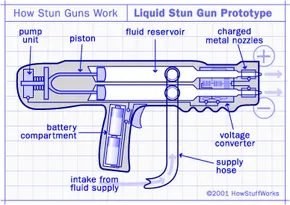
Stun technology surpasses the familiar Taser. A new candidate for non-lethal weapons is the liquid stun gun. It works on the same principle as a projectile taser, but uses a stream of highly conductive fluid instead of a wire.
The device is based on a tank of liquid, which is usually a mixture of water, salt and other conductive elements. Pull the trigger. The electrical current travels from the gun through a stream of liquid to the target.
This design offers distinct advantages. It has a longer range than a standard Taser model. You can fire several times in a row without reloading. But there are also trade-off. Devices are more cumbersome. You have to carry conductive liquid.
High-powered versions is mount on vehicle water cannon. Portable models often look like backpacks. Many use the same pump mechanism as supersoakers. This is a practical but heavy crowd control solution.
Why law enforcement authorities are looking for liquid solutions
The field of stun guns is expanding rapidly. Why? Because the police and military need a way to subdue angry mobs. They must avoid civilian casualties.
Not everyone wants a gun. Even though many people don’t like guns, but still seek safe weapons. This need drives innovation. Technology is advancing. Star Trek-style phasers are no longer a fantasy. A teleporter? Still waiting for it.
For now, the focus is on incapacitation without death. Liquid stun guns are suitable for this purpose. They provide range. It can be reused. arguably less messy than blood.
The Prison Context: Stun Belts
This technology isn’t just for the streets. It is also used in prisons. Stun belts are attached to offenders. Corrections officers hold the remote.
If an inmate acts out, the officer activates the belt. The electric charge hits the kidneys. The inmate is stunned. Officers can then drag them back to their cells.
This is a method of intimidation and control. It keeps the peace behind bars. This is controversial. This is also true.
How does it compare to a traditional Taser?
Comparing a liquid stun gun to a traditional taser, you can see that there are structural differences between the two. Tasers use probes connected by wires. Liquid guns use a conductive stream.
| Features | Traditional Taser | Liquid Stun Gun |
|---|---|---|
| Conductivity | Wire/Probe | Liquid Stream |
| Range | Limited by wire length | Longer, fluid-based |
| Ammunition | Disposable probes | Rechargeable Liquid Tank |
| Portability | Handheld | Backpack or vehicle-mounted |
The fluid flow allows for longer reach. You don’t have to worry about the wire length. You don’t have to replace probes. Just keep pumping the liquid.
The future of non-lethal weapons
Non-lethal weapons are here. They are growing. They are increasingly complex.
The goal is clear. subdue without killing. The means are constantly developing. The liquid gun is the first step. Stun belts are another.
Will we see the phasers soon? Maybe. Will there be teleporters? Probably not.
But liquid stun guns are real. And things are getting better. It’s not a question of whether it works. The question is how far we will let it go.
Key Takeaways
- Mechanism : Uses conductive fluid instead of wires and sensors.
- Range : Longer effective range than a standard Taser.
- Capacity : Can fire multiple times without reloading.
- Disadvantages : You have to carry the liquid tank and it is heavy.
- Use example : Crowd control and prisoner security system (stun belt).
Technology is advancing. Ethical questions continue to raise questions. Reality already exists. We live in an age where water is miraculous. It’s just the beginning.


