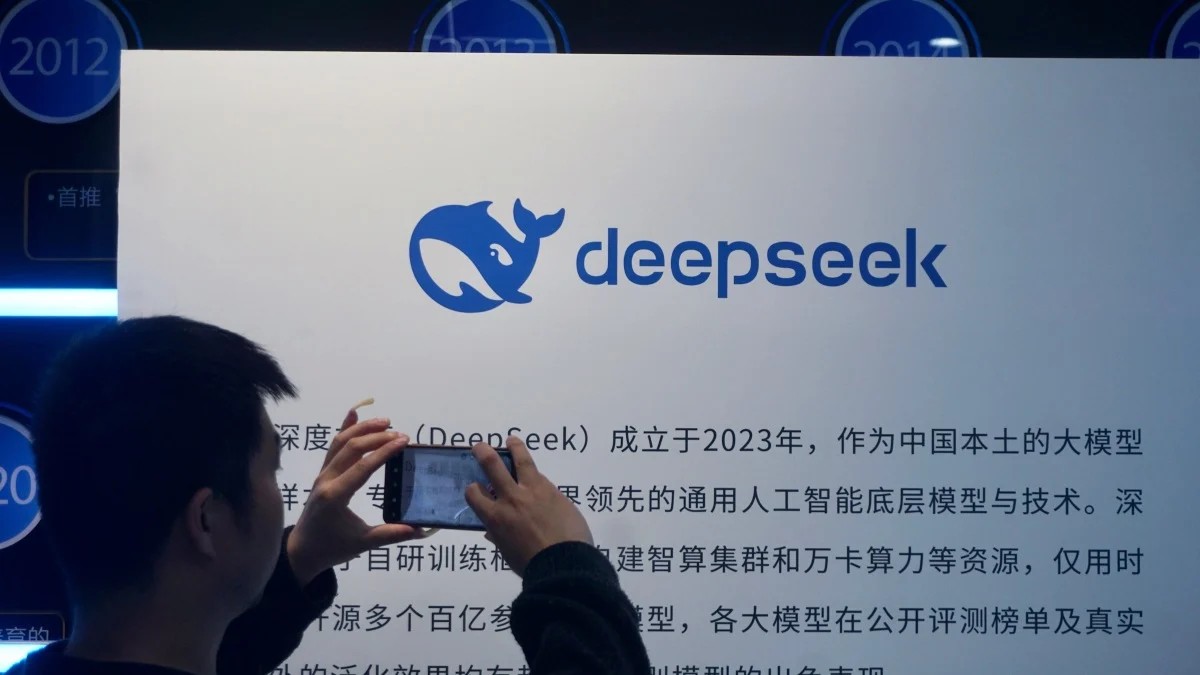
The global AI arms race is no longer just about who has the most powerful model, but who can build them most efficiently and accessibly. As the competition intensifies between U.S. tech giants and Chinese innovators, DeepSeek has released a preview of its latest model, DeepSeek V4, signaling a major shift in the landscape of artificial intelligence.
The Open-Source Advantage
The most defining characteristic of DeepSeek V4 is its accessibility. Unlike the “frontier” models developed by American companies—such as OpenAI’s GPT series, Anthropic’s Claude, or Google’s Gemini—which are kept behind closed doors and strictly controlled, DeepSeek V4 is a true open-source model.
Under an MIT license, anyone can download, modify, and build upon the technology. This approach stands in stark contrast to the proprietary “walled gardens” of Silicon Valley, potentially democratizing high-level AI development for researchers and developers worldwide.
DeepSeek has released two distinct versions to cater to different needs:
– DeepSeek-V4-Pro : A massive model featuring 1.6 trillion parameters.
– DeepSeek-V4-Flash : A leaner, faster version with 284 billion parameters.
Performance: Closing the Gap
DeepSeek claims that V4 has made significant breakthroughs in coding and agentic tasks —the ability of an AI to perform complex, multi-step actions autonomously. The company has also ensured the model is compatible with existing AI agent frameworks like Claude Code and OpenClaw.
While early benchmark results suggest DeepSeek V4 performs on par with the latest models from OpenAI and Anthropic, it currently trails slightly behind on major leaderboards like LMSYS Arena and Artificial Analysis. However, as the model matures and user testing increases, these rankings are expected to fluctuate.
The Efficiency Revolution: A Massive Price Gap
Perhaps the most disruptive element of DeepSeek V4 is its cost structure. DeepSeek has built a reputation for “doing more with less,” a trend that first emerged with their R1 model in early 2025. By optimizing how models are trained and run, they have achieved a level of economic efficiency that U.S. competitors have yet to match.
When comparing API pricing (per 1 million tokens), the disparity is striking:
| Model | Input Cost (per 1M tokens) | Output Cost (per 1M tokens) |
|---|---|---|
| DeepSeek V4 | $1.74 | $3.48 |
| Google Gemini 3.1 Pro | $2.00 | $12.00 |
| Claude Opus 4.7 | $5.00 | $25.00 |
| GPT-5.5 | $5.00 | $30.00 |
Why this matters: For businesses integrating AI into their daily operations, these numbers are transformative. A task that costs roughly $35 using GPT-5.5 would cost only about $5 using DeepSeek V4. This represents an 85% cost reduction, providing a massive incentive for mass adoption in the enterprise sector.
Context: The Geopolitical Dimension
The release of DeepSeek V4 is not just a technical milestone; it is a geopolitical one. It highlights the growing capability of Chinese AI firms to compete directly with Silicon Valley, not just in intelligence, but in resource efficiency and openness. As the U.S. and China continue to vie for AI supremacy, the ability to produce high-performing models at a fraction of the cost could shift the balance of technological influence.
DeepSeek V4’s combination of open-source availability and extreme cost-efficiency poses a direct challenge to the dominant business models of the world’s leading AI laboratories.
Conclusion
DeepSeek V4 represents a strategic pivot in the AI industry, moving the goalposts from pure performance to extreme economic efficiency and open access. If the model continues to close the performance gap with its U.S. rivals, its low cost could trigger a massive wave of adoption across the global developer community.