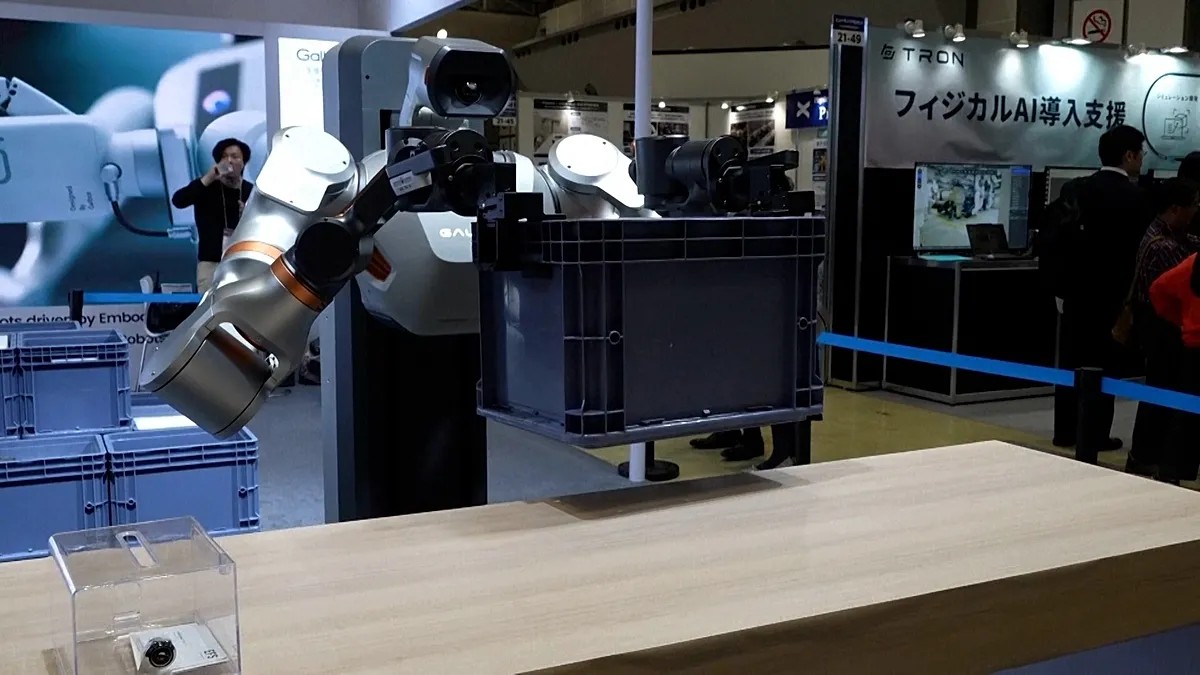
At the recent Humanoid Robot Expo in Tokyo, a human-sized machine named Galbot demonstrated more than just mechanical dexterity; it displayed personality. After picking up a bottle of tea, the robot joked about avoiding sunburn on its future holidays. While the humor was engaging, the underlying reality of the exhibition was more serious: a high-stakes technological competition is unfolding between Japan and China.
The Shift from Hardware to “Physical AI”
While the expo featured many humanoid models developed by Chinese companies—underscoring Beijing’s growing dominance in robotics manufacturing—Japanese firms are pursuing a different strategic path. Rather than competing solely on the production of the physical machines, Japan is pivoting toward “physical AI.”
In the context of robotics, physical AI refers to the bridge between digital intelligence and real-world interaction. Unlike generative AI (such as ChatGPT) which processes text and images, physical AI uses sensors to help machines perceive, interpret, and act within physical environments.
Key players in this niche include:
– Data Infrastructure: Companies like FastLabel are focusing on the “core” of robot intelligence. Instead of building the robots themselves, they create the high-quality, scalable training data required to build sophisticated AI models.
– Cross-Border Collaboration: Interestingly, this Japanese expertise is already being exported; FastLabel works with China’s RealMan to support the development of robot AI models.
The “Dexterity Gap”: From Dancing to Doing
A significant hurdle remains in moving robots from entertainment to utility. Industry experts note a massive technical gap between “pre-defined” movements and “autonomous” decision-making.
“With dancing, for example, you’re just having the robot repeat the same movements… But movements at a higher level are not fixed or pre-defined, and the robot has to make its own judgments,” explains Masato Ando of Aska Corporation.
This distinction is critical. For a robot to be useful in a factory or a home, it cannot simply follow a loop; it must be able to navigate unpredictable environments and perform complex tasks, such as gripping delicate objects or reacting to sudden changes in its surroundings.
Societal Impact and the Labor Challenge
The push for humanoid robotics is driven by urgent demographic shifts. Japan, possessing one of the world’s most rapidly aging populations, faces chronic labor shortages. Humanoid robots are being positioned as a solution for:
1. Manufacturing: Automating repetitive or strenuous tasks in industries facing a shrinking workforce.
2. Domestic Support: The long-term potential to assist elderly citizens in their homes.
However, the transition is not merely a technical one; it is a social one. There remains a palpable sense of unease regarding how closely humans will work with machines. Organizers of the expo emphasize that the goal is coexistence rather than replacement, envisioning robots as “partners” that collaborate with humans to fill societal gaps.
Conclusion
As China leads in hardware manufacturing, Japan is betting on becoming the indispensable provider of the “brains” and data behind the machines. The success of this strategy will depend on whether these robots can move beyond choreographed routines to master the unpredictable complexities of real-world labor.