


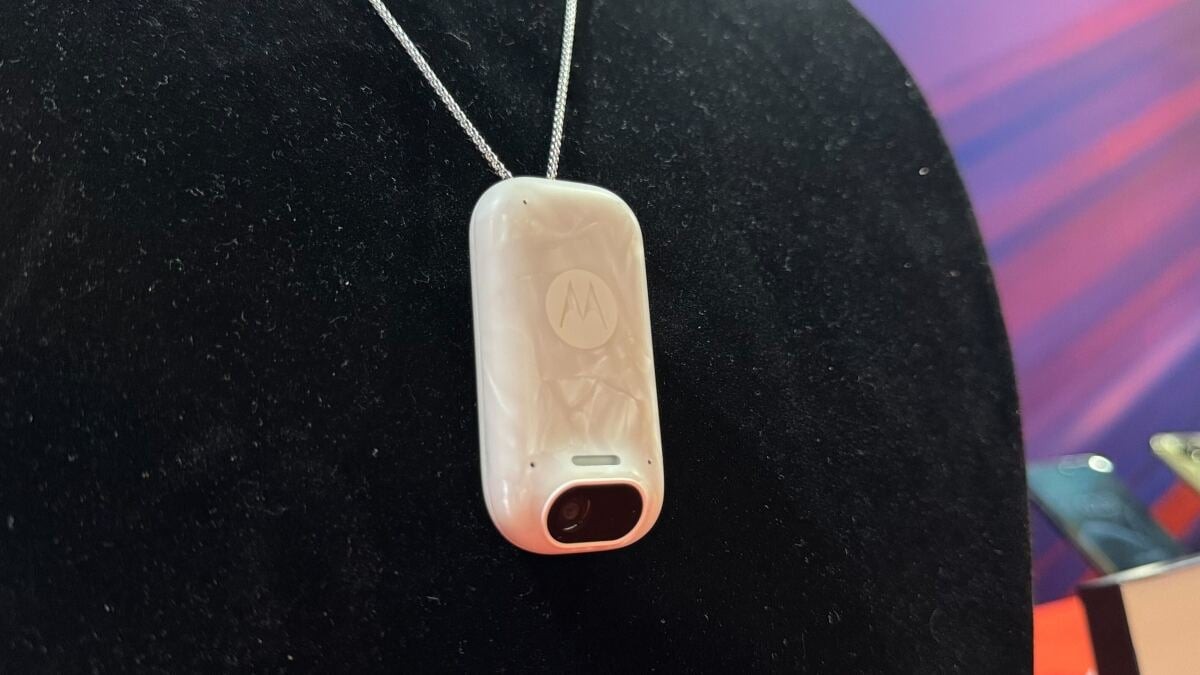
Motorola is making a play for the emerging wearable AI market, debuting a working proof-of-concept device at CES 2026. The company’s new AI assistant, Qira, powers the hardware, which aims to be a more streamlined alternative to existing products like Humane’s AI Pin and the Friend necklace.
Minimalist Design, Agentic Functionality
The device itself is notably small and understated, resembling a thick pendant rather than a traditional wearable. Encased in a polished, pearl-like shell with no visible buttons or displays, it features a built-in camera, sensor array, and subtle Motorola branding.
In demonstrations, the wearable showed some potential for agentic AI behavior. It autonomously launched Google Maps on a paired phone and input a destination when prompted, suggesting a level of proactive function beyond simple voice assistance. However, other demos proved less compelling, such as the device reading event flyers aloud without substantial additional context.
The Wearable AI Landscape
The move comes as several tech companies race to create a mainstream wearable AI companion. Motorola’s entry arrives after high-profile failures and controversies in the space. Humane’s AI Pin, which launched with high expectations, quickly drew criticism for limited functionality and a steep price. The Friend necklace, meanwhile, faced immediate backlash for alleged design theft.
Motorola representatives emphasized that this wearable is still in the early stages of development and has no confirmed release date. The company appears to be testing the waters cautiously, likely learning from the missteps of competitors.
Why This Matters
The wearable AI market is still largely undefined. While many companies have attempted to break into this space, few have succeeded. The failure of Humane’s AI Pin and the controversy surrounding the Friend necklace highlight the challenges: high prices, limited usefulness, and ethical concerns. Motorola’s approach could succeed if it delivers a genuinely useful product without repeating those mistakes.
The key will be striking a balance between functionality, affordability, and design. If Motorola can nail that, it might have a real chance of becoming a major player in the future of wearable AI.


