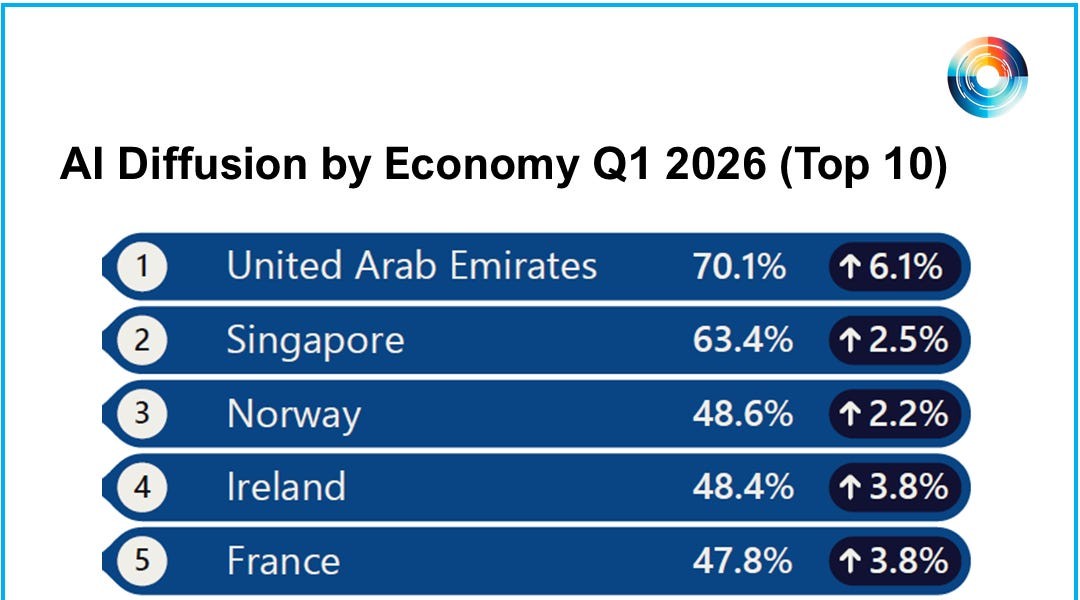
The United Arab Emirates has significantly widened its gap as a global leader in artificial intelligence adoption, reinforcing its position at the forefront of the technology race. This development was highlighted in the latest episode of Middle East AI News, a daily briefing designed for technology, business, and government leaders seeking concise insights into regional tech trends.
The UAE’s Expanding Lead
The primary focus of the recent update is the UAE’s continued dominance in implementing AI solutions across various sectors. While specific metrics were not detailed in the brief summary, the assertion of an “extended global lead” suggests that the nation is outpacing competitors in both the speed and scale of AI integration. This trajectory aligns with broader national strategies aimed at diversifying the economy away from oil dependence and positioning the country as a hub for future technologies.
Regional AI Developments
Beyond the UAE, the Middle East is witnessing significant AI activity in neighboring countries, indicating a broader regional shift toward digital transformation:
- Kazakhstan’s Smart City Ambitions: Presight, an AI company, is expanding its operations in Kazakhstan, specifically targeting smart city infrastructure. This move highlights a growing interest in using predictive AI to manage urban resources, traffic, and public safety more efficiently.
- Egypt’s Software Testing Innovation: Egypt is showcasing new advancements in AI-driven software testing. By automating quality assurance processes with AI, the country is aiming to improve the reliability and speed of software development, a critical component for any growing tech ecosystem.
Context and Implications
These developments underscore a strategic pivot in the Middle East. Nations are no longer just consuming technology; they are actively building ecosystems that support AI hardware, software, and infrastructure.
Why this matters: The competition is no longer just about having the best algorithms; it is about real-world application. The UAE’s leadership in adoption, combined with Kazakhstan’s focus on urban AI and Egypt’s improvements in software reliability, paints a picture of a region moving from theoretical research to practical, scalable implementation.
About the Source
This news was disseminated via the Middle East AI News Minute podcast, hosted by Carrington Malin and sponsored by Positron AI. The sponsor, Positron, focuses on efficient AI inference hardware, emphasizing the importance of low-power, cost-effective datacenter solutions for the “post-training era” of AI.
Note: The podcast utilizes an AI-cloned voice for narration. While convenient, listeners are advised that there may be occasional mispronunciations of Arabic words and place names.
Conclusion
The UAE is not only maintaining but actively expanding its status as a global AI leader, while neighboring nations like Kazakhstan and Egypt are making targeted strides in smart cities and software development. This collective progress signals a robust and accelerating AI ecosystem across the Middle East, driven by both government strategy and private sector innovation.