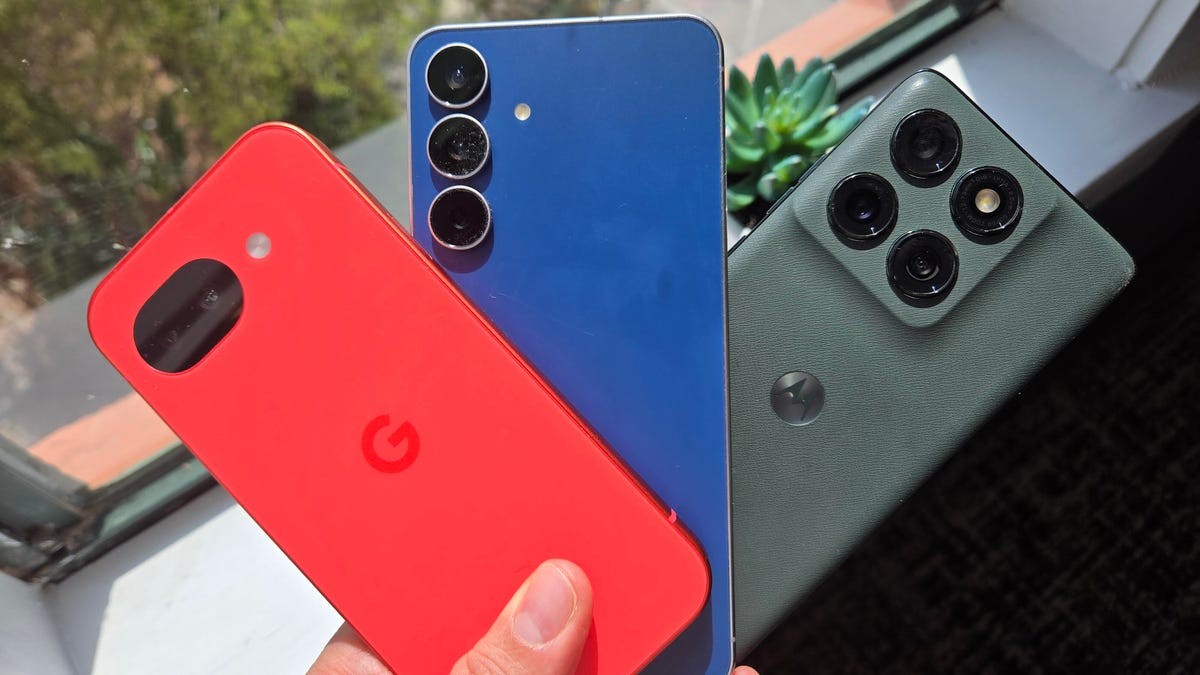
Google’s $499 Pixel 10A, Samsung’s $650 Galaxy S25 FE, and Motorola’s $550 Edge were put to the test in a real-world camera comparison. The goal was simple: how does the Pixel 10A, priced aggressively, stack up against its mid-range rivals in various shooting scenarios? The results show that while all three phones have strengths, the Pixel holds its own surprisingly well.
Real-World Testing: St. Petersburg, Florida
The testing spanned across diverse conditions – bright sunlight, indoor coffee shops, and low-light brewery settings – all challenging for phone cameras. The key takeaway is that while sensor size matters, software processing and lens versatility can compensate for hardware differences.
Outdoor Performance: Bright Light & Detail
In direct sunlight, the Pixel 10A produces clear, detailed images, though with noticeable processing to enhance exposure. The Samsung Galaxy S25 FE and Motorola Edge also captured bright scenes effectively, but with slightly brighter pavements. The S25 FE and Edge both feature a 3x optical zoom, a feature the Pixel lacks, allowing for clearer distant shots. While the Pixel uses digital zoom, it struggles to maintain the same level of detail at longer ranges.
The S25 FE demonstrated the best color reproduction at 3x zoom, while the Edge’s telephoto lens produced a yellowish hue in comparison. This highlights a crucial difference: while all three phones perform adequately, the S25 FE’s optical zoom provides a clear advantage in clarity and color accuracy.
Indoor Shots: Ultrawide Lens Comparison
Inside Southern Grounds coffee shop, the Pixel 10A and S25 FE delivered balanced colors and details, while the Motorola Edge struggled to distinguish between toast shades, rendering some parts darker than they were. Zooming in, the Pixel and S25 FE captured more page markings in a notebook, showcasing superior detail retention. Despite the Edge’s higher megapixel count, its ultrawide camera underperformed in this setting.
This illustrates that megapixels alone don’t guarantee quality; software optimization and lens calibration play a significant role in indoor photography.
Low-Light Photography: Nighttime at 3 Daughters Brewing
At night, all three phones produced decent results, but the Motorola Edge exhibited noticeable streaks in the sky and image noise, suggesting weaker processing capabilities. The Pixel and S25 FE toned down glare effectively, while the Galaxy S25 FE captured sharper furniture details. The Galaxy S25 FE again outperformed, capturing cleaner images in challenging lighting conditions.
This scenario emphasizes the importance of computational photography: the ability to process and refine images in low light is critical for producing usable results.
Selfies: Color and Detail
Selfie tests revealed varying styles. The Pixel 10A brightened faces, while the S25 FE captured more details with a darker tone. The Motorola Edge smoothed out selfies, resulting in different color renditions. The Galaxy S25 FE again stood out with the most detail capture, including hair strands and fabric textures.
The differences in selfie performance underscore how each manufacturer prioritizes different aesthetic preferences.
Conclusion
The $499 Pixel 10A competes effectively with the $550 Motorola Edge and $650 Samsung Galaxy S25 FE. While the Galaxy S25 FE offers a telephoto lens for improved zoom, the Pixel’s low cost and strong photography capabilities make it a compelling option. The Motorola Edge struggles in low light, despite its 3x optical zoom. Ultimately, the Pixel 10A proves that impressive camera performance doesn’t always require a high price tag.