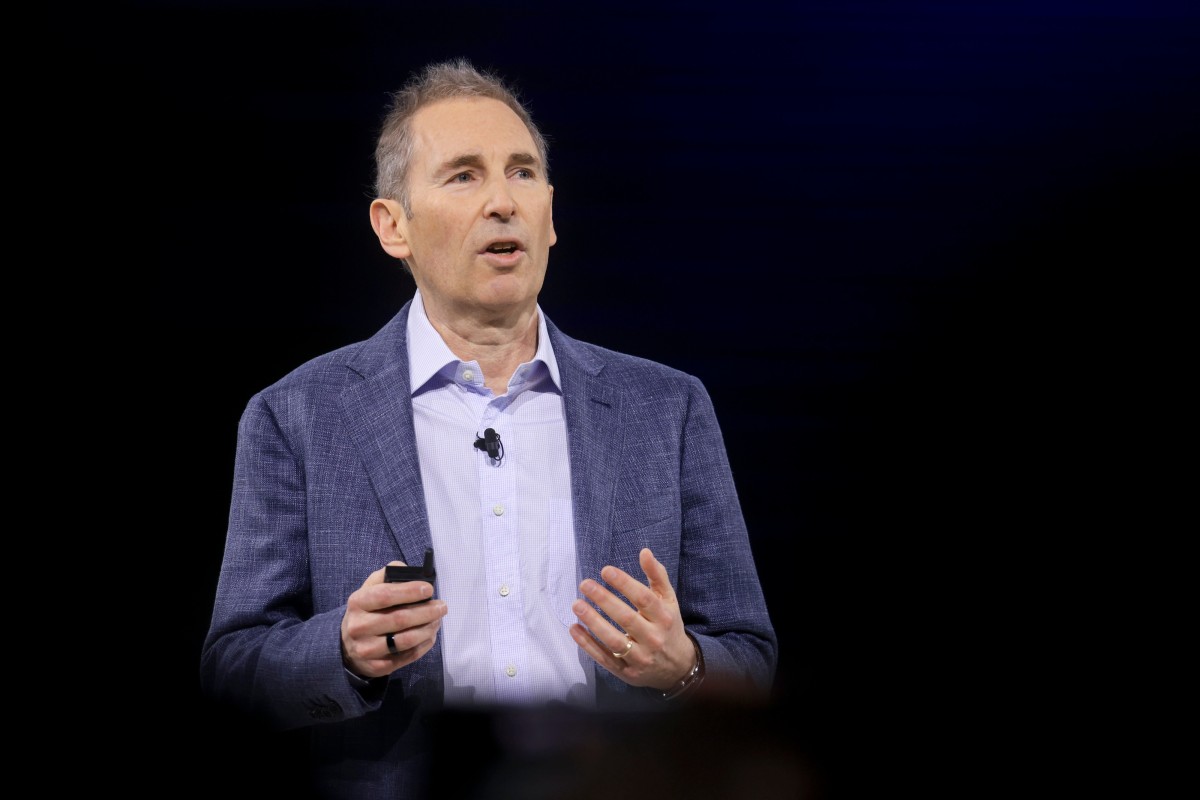
In his annual letter to shareholders, Amazon CEO Andy Jassy laid out a high-stakes roadmap for the company’s future. While the tone was professional, the underlying message was clear: Amazon is aggressively moving to reduce its reliance on external hardware providers and build a self-sustaining ecosystem of AI and cloud infrastructure.
By highlighting the success of proprietary chips and massive capital investments, Jassy is signaling that Amazon intends to compete directly with industry titans like Nvidia, Intel, and Starlink.
The Battle for Silicon Supremacy
For much of the recent AI boom, Nvidia has been the undisputed king of the hardware market. However, Jassy noted a fundamental shift in customer priorities. While Amazon maintains a strong partnership with Nvidia, his letter suggests that AWS (Amazon Web Services) customers are increasingly demanding better price-performance —a niche Amazon is filling with its own custom-designed chips.
- The Trainium Success: Amazon’s homegrown AI chips, specifically the Trainium series, are seeing unprecedented demand. Jassy revealed that capacity for the upcoming Trainium3 is nearly sold out, and even Trainium4 —which is still 18 months away—is already seeing its capacity fully committed.
- Revenue Milestones: Amazon’s custom chip business has reached an annual revenue run rate of $20 billion. Jassy noted that if Amazon were a dedicated semiconductor company selling these chips to the open market, that figure could reach $50 billion.
- Challenging Intel: Amazon is also making significant inroads into general computing. The company’s Graviton CPU (an alternative to Intel’s x86 architecture) is now used by 98% of the top 1,000 EC2 customers. The demand is so high that some clients have requested to purchase Amazon’s entire Graviton capacity for 2026.
Expanding the Frontier: Satellite Internet and Robotics
Beyond the data center, Amazon is positioning itself as a major player in global connectivity and industrial automation.
Project Kuiper (Amazon Leo)
Amazon is preparing to take on SpaceX’s Starlink in the satellite internet race. Scheduled for launch in mid-2026, Amazon’s satellite initiative has already secured high-profile contracts with NASA, Delta Airlines, AT&T, and Vodafone. This suggests that Amazon is not just building a service, but an entire global communications infrastructure.
The Future of Robotics
Jassy hinted at a potential new business frontier: Robotics-as-a-Service. By leveraging the data collected from its fleet of one million warehouse robots, Amazon may eventually package its automation expertise into solutions for other industrial and consumer markets.
The $200 Billion Bet: Is it a Bubble?
Perhaps the most controversial part of the letter addresses Amazon’s massive capital expenditure (Capex). Amazon plans to spend approximately $200 billion in 2026 alone, primarily to build out the data centers required to power the AI revolution.
This level of spending has sparked debate among investors regarding whether the AI industry is currently in a “bubble.” Jassy addressed these concerns directly:
– He argued that these investments are not “hunches” but are backed by concrete demand.
– He cited a significant agreement with OpenAI, which has pledged to spend $100 billion on AWS.
– He noted that several other large-scale customer agreements are already in place or being finalized.
“We’re not investing approximately $200 billion in capex in 2026 on a hunch,” Jassy stated, defending the company’s aggressive expansion.
Conclusion
Amazon is executing a massive vertical integration strategy, designing its own chips, building its own satellite networks, and expanding its robotics capabilities. While the scale of their $200 billion investment carries inherent risk, Jassy’s letter makes it clear that Amazon is betting its future on becoming the foundational infrastructure for the AI era.