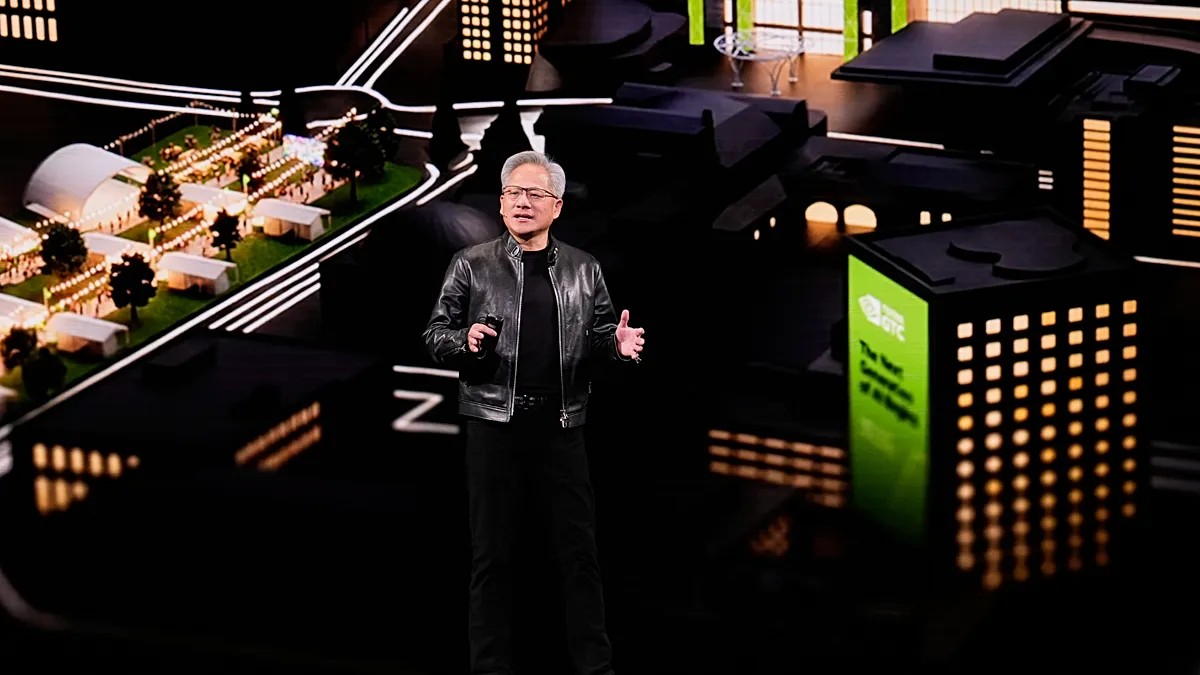
Nvidia CEO Jensen Huang delivered a series of major announcements at the company’s annual conference, signaling a rapid expansion of artificial intelligence (AI) capabilities into autonomous systems, space computing, and everyday business tools. The moves demonstrate Nvidia’s intent to dominate next-generation computing, from the cloud to the streets… and even into orbit.
AI Agents: Open-Source Power with Enterprise Security
Nvidia unveiled NemoClaw, an open-source platform designed to bring powerful AI agents directly into businesses. These autonomous software programs operate without constant human oversight, capable of making decisions and taking actions independently.
NemoClaw builds on the controversial OpenClaw project, created by Austrian developer Peter Steinberger. OpenClaw gained notoriety for its ability to run AI bots that interact autonomously – sometimes questionably – on social media (as seen in the MoltBook platform). The original OpenClaw was criticized for potential security risks, including unauthorized data sharing. Nvidia collaborated with Steinberger to address these concerns, offering a more secure model for enterprise deployment. Huang emphasized the impact of OpenClaw, calling it the most influential open-source project ever.
“Every single company in the world today needs to have an OpenClaw strategy. This is the new computer.” – Jensen Huang
Steinberger has since joined OpenAI, but his software will remain open-source.
Computing in Space: A New Era of Real-Time Processing
Nvidia revealed the Space-1 Vera Rubin Module, a high-performance GPU designed to power data centers in orbit. This system delivers up to 25 times more compute power than Nvidia’s existing chips, enabling advanced AI tasks directly in space.
The implications are significant: satellites will be able to process data instantly, without the delays of transmitting it back to Earth. This unlocks real-time AI analysis for tasks like weather forecasting, environmental monitoring, and even military intelligence. Huang acknowledged the challenges of space computing – particularly cooling systems – but emphasized that Nvidia is solving these problems with radiation-hardened technology, such as the IGX Thor robotics platform.
The Space-1 Vera Rubin Module does not yet have a release date.
Autonomous Vehicles: Scaling Robotaxi Networks Globally
Nvidia is partnering with European rideshare app Bolt to deploy Level 4 autonomous vehicles across the continent. Bolt will leverage Nvidia’s robotaxi platform, which uses data from lidar, cameras, and radar to operate without human intervention. The move aims to create a European-led AV offering, giving the continent control over its mobility data and technology.
This partnership adds to Nvidia’s growing network of automotive partners, including BYD, Hyundai, Nissan, Geely, and Uber. Huang declared that the “ChatGPT moment of driving cars has arrived,” signaling that fully autonomous driving is now demonstrably achievable. Bolt aims to deploy 100,000 autonomous vehicles by 2035.
In conclusion, Nvidia’s announcements at GTC 2024 underscore the company’s ambition to lead the next wave of computing innovation. From securing AI agents for business to deploying powerful processing in orbit, Nvidia is pushing the boundaries of what’s possible with artificial intelligence, autonomous systems, and high-performance computing.