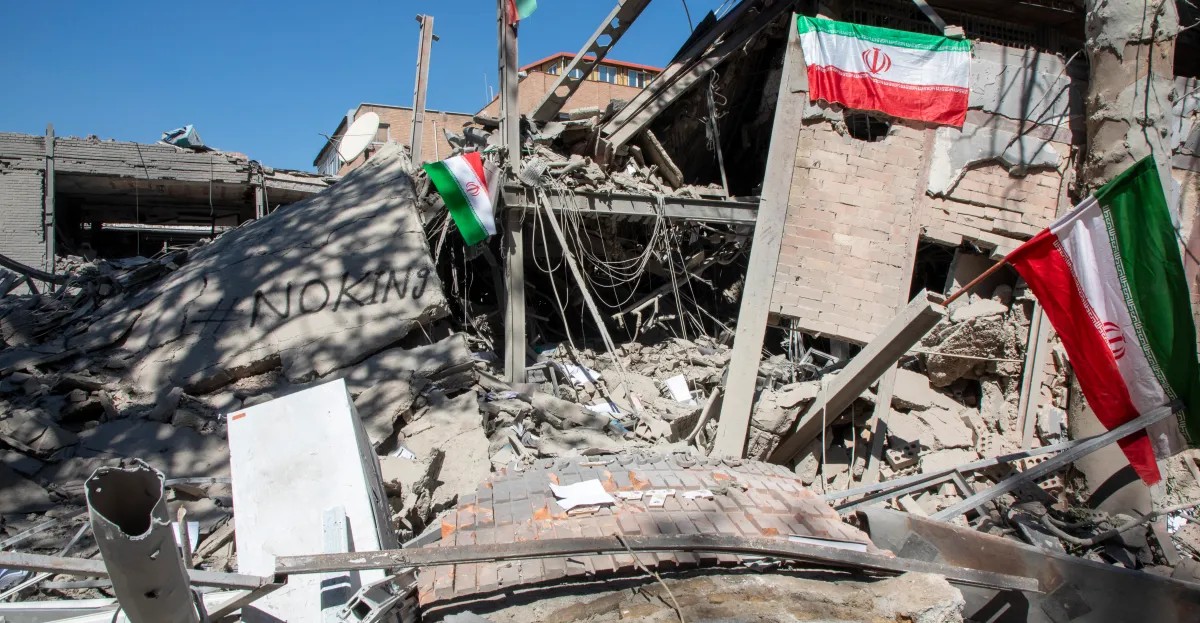
As the United States engages in military action against Iran, observers are increasingly drawing parallels to the 2003 invasion of Iraq. The similarities are striking: both conflicts feature overwhelming American military dominance paired with shifting, often ambiguous strategic objectives, and both are led by presidents eager to declare victory before stability has actually been achieved.
In a recent discussion on Today, Explained, veteran journalist Dexter Filkins—who served as a Baghdad correspondent for the New York Times —shared his concerns regarding the current trajectory of U.S. involvement in Iran.
The Illusion of “Mission Accomplished”
A central theme in the comparison between these two conflicts is the gap between military success and political stability. Filkins recalls the infamous “mission accomplished” moment during the Iraq War, where President Bush declared victory while the country was descending into chaos.
The distinction between winning a battle and winning a war is critical:
– Military Dominance vs. Order: The U.S. military is highly effective at destroying enemy targets and dismantling regimes. However, destroying a government does not automatically create a functional state.
– The Vacuum of Power: In 2003, the moment the U.S. entered Baghdad, the lack of a plan for post-invasion order led to immediate anarchy, looting, and bloodshed.
– The Sustainability Problem: Without a mechanism to maintain order and rebuild social structures, military victory becomes a “cruel joke.”
“The U.S. military is really good at what they do, and what they do is destroy their enemies. But that is not enough necessarily to make a just and lasting peace… and that will, say, allow the United States to leave.”
The Regional and Domestic Fallout
The consequences of the Iraq War extended far beyond the borders of Iraq, creating a “self-sustaining firestorm” that reshaped the Middle East. Filkins notes that the invasion acted as a magnet for extremists from across the Islamic world, who viewed the U.S. not as a liberator, but as an occupying force.
Domestically, the Iraq War left a deep scar on the American psyche. The failure to find weapons of mass destruction (WMDs) led to a profound sense of betrayal among the public. This loss of trust in government intelligence and leadership created a lasting skepticism regarding the justifications for foreign intervention.
Parallel Concerns in the Iran Conflict
When examining the current situation in Iran, Filkins identifies several troubling patterns that mirror the early years of the Iraq War:
- Ambiguous Justifications: Much like the lead-up to the Iraq War, there is a perceived lack of clarity regarding the ultimate goals of the current administration. President Trump has provided various justifications for the conflict, which complicates the democratic mandate for war.
- Humanitarian Costs: The reality of modern warfare includes tragic civilian casualties, such as recent reports of school bombings. While these are inherent risks of conflict, they add to the moral and political burden of the war.
- The Risk of “Forever Wars”: There is a growing fear that the U.S. is once again entering a cycle of intervention that lacks a clear exit strategy, potentially leading to long-term regional destabilization.
Looking Ahead: The Search for an Exit
While the situation in Iran appears deeply concerning, the focus is shifting from how the war began to how it might end. The primary objective for policymakers, according to Filkins, must be a resolution that prevents a global economic catastrophe.
A key priority is ensuring the Strait of Hormuz remains open to prevent a global recession. The ultimate goal is an “extrication” that avoids leaving the Middle East in a state of even greater chaos than the one currently being addressed.
Conclusion: The primary lesson from the Iraq War is that military might can dismantle a regime, but it cannot, on its own, build a lasting peace. As the U.S. navigates the conflict in Iran, the challenge remains to find a path toward stability that avoids the cycle of anarchy and long-term occupation.