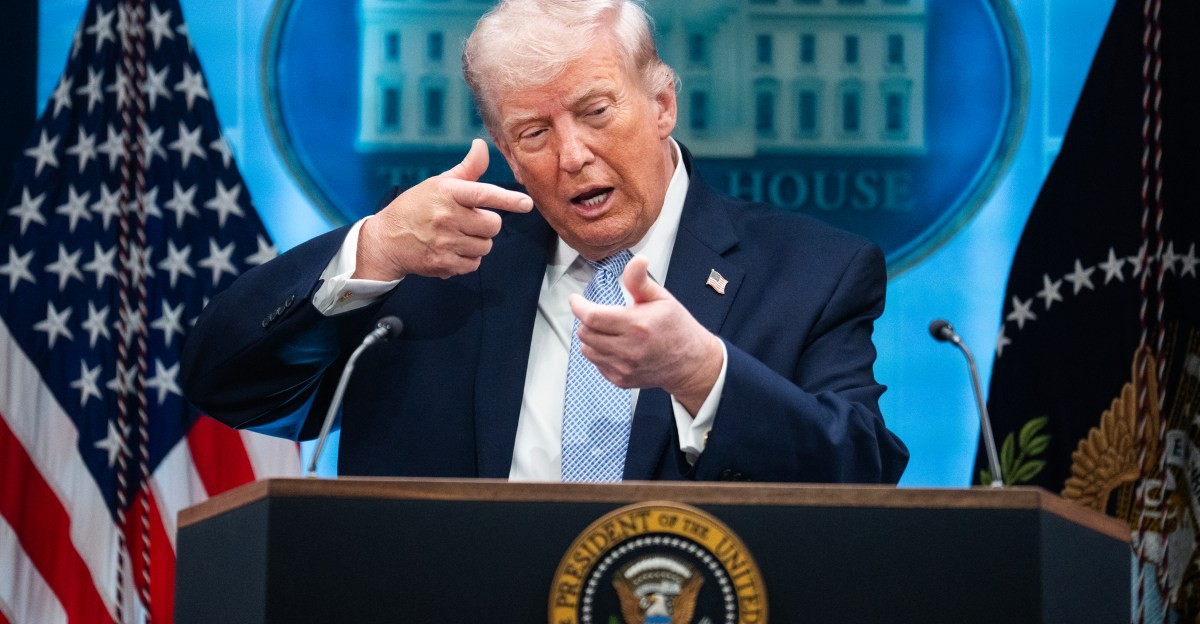
Recent political tensions have brought an obscure constitutional tool back into the spotlight: the 25th Amendment. Following controversial rhetoric from President Donald Trump regarding Iran, over 70 Democratic lawmakers—along with several prominent voices on the far right—called for the Cabinet to invoke this provision to temporarily prevent him from exercising presidential powers.
While the calls for action reflect deep-seated political anxieties, they overlook a fundamental reality: under the current American constitutional framework, removing a sitting president is an extraordinarily difficult and unlikely feat.
Understanding the 25th Amendment
To understand why these calls are often more symbolic than practical, one must look at the amendment’s original intent. Ratified in 1963 following the assassination of John F. Kennedy, the 25th Amendment was not designed to address political instability or controversial policy decisions. Instead, it was created to solve a specific procedural problem: how to transfer power if a president is physically or mentally incapacitated but still alive.
The amendment outlines a rigorous and highly complex process:
- The Initial Declaration: The Vice President and a majority of the Cabinet must formally declare that the President is “unable to discharge the powers and duties of his office.”
- The Presidential Rebuttal: The President can immediately fight to regain authority by submitting a written declaration stating that no such inability exists.
- The Congressional Hurdle: Once the President contests the removal, Congress must decide. To keep the President sidelined, two-thirds of both the House and the Senate must vote to uphold the Cabinet’s decision.
- The Time Limit: If Congress fails to act within 21 days of the President’s rebuttal, the President automatically regains full executive powers.
Why Removal is Virtually Impossible
In practice, the 25th Amendment is even more difficult to execute than the impeachment process. While impeachment requires only a simple majority in the House, the 25th Amendment requires a supermajority in both chambers of Congress.
For a president like Trump, the math is nearly insurmountable. To invoke the amendment, his own hand-picked Cabinet members and Vice President JD Vance would have to turn against him. Even if they did, the Republican-controlled Congress would be unlikely to provide the two-thirds supermajority required to strip a president of his power against his will.
The process is designed for medical emergencies, not political disagreements. Using it to address a president’s conduct would require a level of bipartisan consensus that rarely exists in modern American politics.
The U.S. vs. Parliamentary Democracies
The difficulty of removing a U.S. president highlights a fundamental difference between the American presidential system and parliamentary democracies found in countries like the United Kingdom, Canada, Germany, or Japan.
| Feature | U.S. Presidential System | Parliamentary Systems |
|---|---|---|
| Executive Selection | Elected separately from the legislature. | Chosen by the legislature. |
| Removal Mechanism | Impeachment or 25th Amendment (extremely difficult). | “No-confidence” votes (often requires only a simple majority). |
| Political Impact | Removal often triggers a massive constitutional crisis. | Removal is a standard political tactic to refresh leadership. |
In parliamentary systems, political parties have a built-in incentive to replace leaders who become unpopular or ineffective. For example, the UK’s Conservative Party has successfully replaced Prime Ministers (such as Margaret Thatcher) to maintain their hold on power without collapsing the government.
In contrast, the U.S. system is designed to protect the independence of the executive branch, which often results in a “deadlock.” A president can remain in power even if they have lost the confidence of both Congress and the public, provided they hold their mandate through the election.
Conclusion
While the 25th Amendment serves as a vital safeguard for instances of medical incapacity, it is not a viable tool for addressing political or behavioral concerns. Given the high threshold of a two-thirds congressional vote, the United States remains structurally committed to its elected leaders until their terms expire.