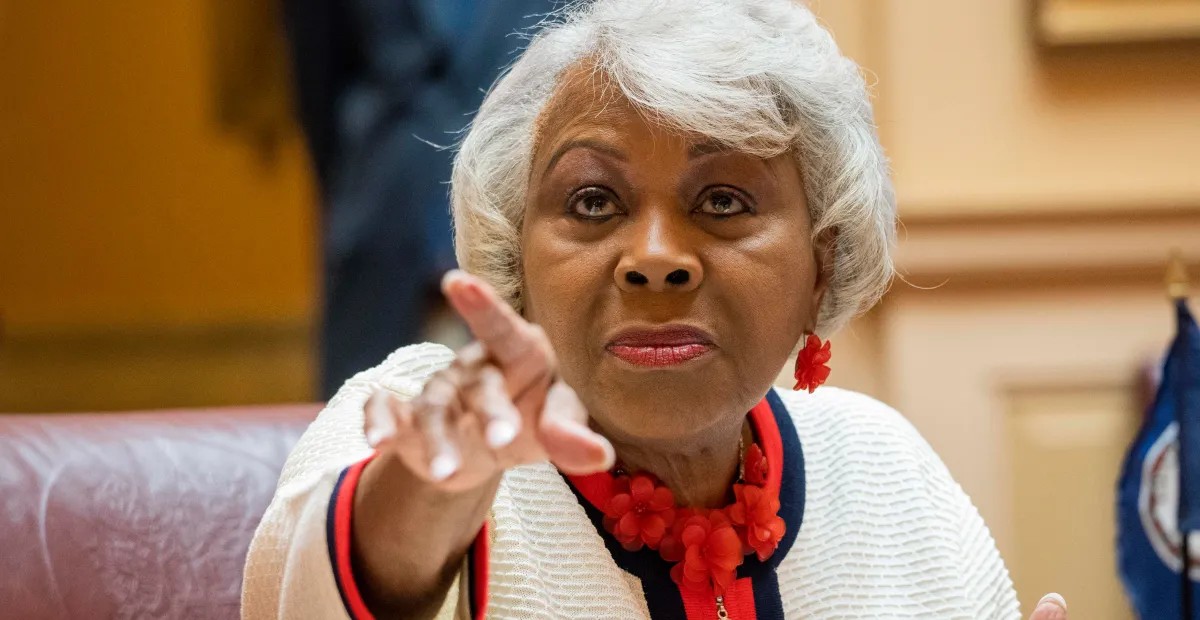
The recent FBI raid on the office of Virginia State Senator Louise Lucas has ignited a fierce debate about the integrity of the Trump administration’s Justice Department (DOJ). The operation, which targeted an 82-year-old Democrat and powerful figure in Virginia politics, unfolded under suspicious circumstances that raise serious questions about political motivation versus legitimate law enforcement.
While the DOJ maintains it is pursuing a three-year-old bribery investigation, the timing, media handling, and internal pressures surrounding the raid suggest a more complex narrative. This incident sits at the intersection of legal procedure, political strategy, and constitutional ethics, potentially undermining the very goals the administration seeks to achieve.
A Raid Wrapped in Political Controversy
Senator Louise Lucas is a polarizing figure. As the president pro tempore of the Virginia Senate, she was instrumental in approving the state’s recent 10-1 Democratic congressional map, a move widely seen as retaliation against Republican-drawn maps in other states. Known for her aggressive online presence, Lucas recently posted an AI-generated image depicting four incumbent Republican congressmen working at McDonald’s.
However, the raid on her office in Portsmouth, Virginia, was not merely a symbolic strike. According to reporting by MS NOW, the DOJ has investigated Lucas for alleged bribery for three years—dating back to the Biden administration. This timeline suggests the probe has historical legitimacy. Yet, complications arose when Lindsey Halligan, a former insurance lawyer and Trump’s controversial nominee for U.S. Attorney in eastern Virginia, allegedly pressured prosecutors to accelerate charges before the 2026 midterm elections.
Halligan reportedly believed that accusing a prominent Democrat of bribery would benefit the White House politically. This allegation is significant because Halligan was previously involved in failed or politically contentious prosecutions of Trump’s critics, including former FBI Director James Comey and New York Attorney General Letitia James.
The Fox News Factor: A Breach of Protocol?
Perhaps the most damaging aspect of the raid was the immediate presence of Fox News crews at the scene. In a small city like Portsmouth, having a major network’s Washington-based foreign correspondent on hand within moments of the FBI’s arrival is statistically improbable without prior coordination.
This incident starkly contrasts with standard DOJ protocol. In 2022, then-Attorney General Merrick Garland explicitly stated that the Department speaks only through court filings and legal cases, avoiding extrajudicial comments that could prejudice public opinion. Legal ethics rules strictly prohibit prosecutors from making statements that heighten public condemnation of the accused before a trial.
By allowing—or facilitating—media coverage that framed the raid as a political victory, the DOJ may have inadvertently tainted the jury pool. When accusations are broadcast to the public rather than tested in a courtroom, potential jurors may form preconceived notions about guilt or innocence. For a defendant like Lucas, who is adept at media engagement, this creates a difficult environment for securing a fair trial.
Three Scenarios for the Investigation
To understand the implications of this raid, it is helpful to consider three possible realities behind the investigation:
- Lucas Is Guilty of Serious Crimes: If Lucas committed bribery, the DOJ’s handling of the case is still flawed. The involvement of politically motivated actors like Halligan and the media spectacle create avoidable vulnerabilities. Lucas has already accused the Trump administration of attempting to “intimidate and silence” her, a narrative that will likely resonate with jurors if the prosecution appears politically driven.
- Lucas Is Innocent: If the Biden-era investigation found no actionable evidence, the raid may be a purely political maneuver designed to bolster Republican prospects in the midterms. However, this strategy risks backfiring. Persuadable voters are aware of the broader context, including the prosecutions of Comey and James. Rather than proving Democratic corruption, the raid may reinforce perceptions of partisan retaliation.
- Lucas Committed Minor Offenses: Criminal codes are expansive, and law enforcement often exercises discretion to ignore minor infractions. Historically, the DOJ has safeguards to prevent the harassment of elected officials for trivial matters. If Lucas’s actions were minor but prosecuted aggressively due to her political status, it would represent an abuse of prosecutorial discretion. The DOJ recently suspended policies requiring consultation with the Public Integrity Section before charging members of Congress, raising concerns about unchecked power.
The Pressure on Acting Attorney General Todd Blanche
Another layer of complexity involves Acting Attorney General Todd Blanche. Previously one of Trump’s personal lawyers, Blanche holds a temporary position pending Senate confirmation of a permanent successor. Reports suggest former Attorney General Pam Bondi was removed for failing to effectively target Trump’s political foes.
Blanche faces immense pressure to prove his loyalty and effectiveness. The raid on Lucas’s office may be part of an effort to demonstrate competence to the President. This dynamic is echoed in Blanche’s previous actions, such as the chaotic and legally questionable arrest of Newark Mayor Ras Baraka in May 2025. In that case, a federal magistrate judge criticized the DOJ for using “immense power” to pursue weak cases.
The pattern suggests a Justice Department eager to secure high-profile convictions against political opponents, sometimes at the expense of legal rigor. If Blanche’s tenure depends on delivering political wins, the risk of overreach increases.
Conclusion
The raid on Senator Louise Lucas’s office is more than a local law enforcement action; it is a test of the DOJ’s independence under the Trump administration. Whether Lucas is guilty or innocent, the politicized nature of the investigation threatens to undermine public trust in the justice system. By prioritizing political messaging over procedural neutrality, the Department risks turning a legal case into a spectacle that could ultimately weaken its own credibility.