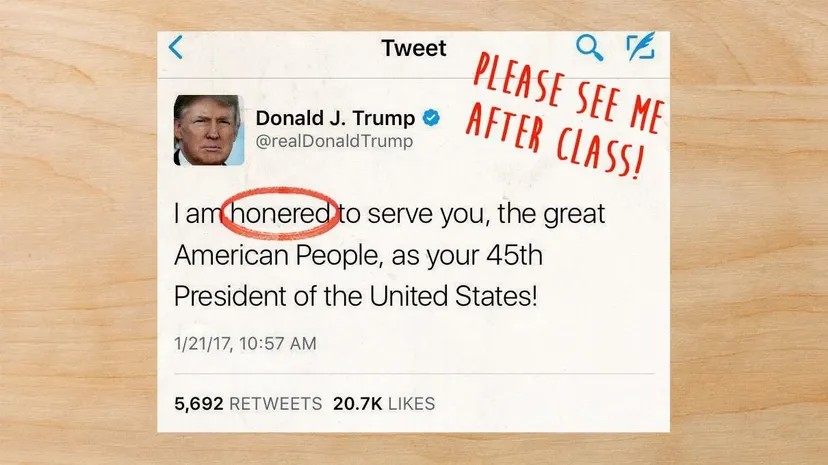
Donald Trump didn’t just tweet during his campaign. He tweeted constantly. And back then, the rules were loose. There were no regulations stopping him from deleting a post or editing a typo. He could do what he wanted.
Then he won. He took the oath of office. The rules changed overnight.
Now, his tweets aren’t just personal thoughts. They are public property. Legal experts argue that means he can’t destroy them. He can’t alter them. At least, that is what the law says.
Yet, soon after inauguration, Trump deleted a tweet. It contained a misspelling of the word honored. He corrected the typo. He posted the same tweet again, this time from the official @POTUS account.
Experts say this might be a violation of federal law. Specifically, the Presidential Records Act of 1978.
How the Law Changed Everything
Before 1978, presidents had free rein. Letters, notes, diaries, correspondence—they were the president’s private property. For nearly 200 years, historical custom dictated this. The president owned his written words.
Watergate changed that.
The scandal exposed how leaders could hide or destroy evidence. Congress responded with the 1978 act. It stripped presidents of ownership. The papers of the president and vice president became public records.
The law imposed strict rules. Staff and presidents must follow them when handling material related to official duties. Constitutional duties. Statutory duties. Ceremonial duties. Everything counts.
The federal government now owns and controls these records. The executive branch must preserve and archive all correspondence. No exceptions.
Do Tweets Count as Official Records?
Yes. And it is not just a guess.
The Presidential and Federal Records Act Amendments of 2014 clarified this. President Barack Obama signed it into law on November 26, 2014. The amendment modernized the 1978 act. It focused directly on electronic records.
Under this update, tweets count. So do Facebook posts. Emails. Social media messages.
The National Archives has the power to safeguard original and classified records. They can stop unauthorized removal. The Archives states that posted tweets are public records.
They have not explicitly stated whether deleted or edited tweets fall under the same protection. This ambiguity matters. Trump deleted a tweet. Did he break the law? Maybe.
Obama’s staff treated his tweets differently. They archived the originals automatically. Even if he sent a corrected version later. The original stayed on record.
Obama used the official @POTUS handle. Trump can use it too. He almost never does.
He tweets from his private handle, @realDonaldTrump. Then he retweets those posts to @POTUS. This creates a messy paper trail. Which version is the official record? The one he deletes? Or the one he keeps?
Why This Matters for You
This is not just about spelling errors. It is about transparency.
If presidents can delete tweets, they can erase history. They can alter the public record. Citizens lose access to what their leaders said. When. And why.
The law exists to prevent this. The 1978 act and its 2014 amendments were designed to keep the executive branch accountable. Electronic records are no longer a loophole.
But enforcement is tricky. The National Archives can safeguard records. But can they retrieve a deleted tweet? If it was never archived properly?
Trump’s actions raise questions. Are tweets sent from a private handle official records? If he deletes them, does the violation occur then? Or only if the government cannot produce them?
The Precedent of Pushback
Presidents have tried to weaken this law before.
In 2001, George W. Bush signed an executive order. It was designed to circumvent the Presidential Records Act. It was part of a series of moves by the executive branch to limit congressional oversight.
Each administration tests the boundaries. Trump is no exception.
The core issue remains the same. Who owns the truth? The president? Or the public?
The law says public. Practice is harder. Tweets disappear. Threads get edited. History gets rewritten.
We wait to see how the Archives responds. We wait to see if experts sue. We wait to see if the next president follows the rules.
Or deletes them.