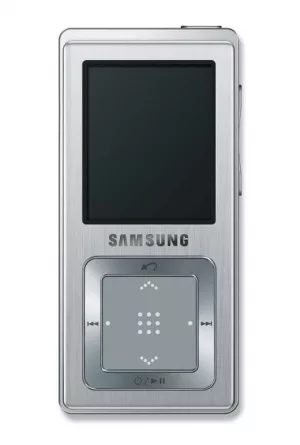
Samsung wants you to carry your entire music library in a pocket that barely exists. The device in question is a ultra-slim portable media player boasting a mere 1.1 centimeters in thickness. It is small. Just 4.2 by 8.9 centimeters. Yet it packs a punch where it counts.
Storage is a healthy 2 gigabytes. That is enough for hundreds of tracks if you are not hoarding uncompressed WAV files. The screen is a 1.8-inch TFT-LC display. It is not a high-res marvel. It is functional. You can see your tracklist. You can navigate menus. It gets the job done without eating battery life faster than a teenager with a smartphone.
Why DNSe Matters for Audiophiles
The headline feature here is Samsung’s proprietary DNSe technology. This stands for Digital Natural Sound Engine. It is not just a buzzword slapped on the casing to justify a higher price tag. It is a real piece of 3D sound technology designed to process your digital music collection.
How does it work? It attempts to reconstruct spatial audio cues. Standard MP3s are compressed. They lose depth. DNSe tries to put that depth back. For casual listeners, it makes the soundstage feel wider. It adds a layer of richness to flat stereo tracks. If you are plugging into decent earbuds, the difference is noticeable. It prevents the audio from sounding thin.
Is it perfect? No. But it is better than the default output on many budget players. It gives your own digital disc collection optimal quality. That is the claim. And for the price point of these compact units, it is a significant selling point.
More Than Just Music: The Photo Feature
Music lovers get the engine. But photo enthusiasts get the interface. Samsung included a slideshow function that turns this device into a mini gallery.
You can load personal JPEG images as backgrounds. This is not just about aesthetics. It is about customization. You can set a favorite photo to loop behind your tracklist. Or you can use the diashow function to create a visual experience.
Here is where it gets interesting. You can pair these images with music. It adds a multimedia layer to what is otherwise a mono-purpose device. The zoom feature allows you to magnify or shrink images. It works smoothly enough for casual browsing. It is not a replacement for a tablet. But it is convenient.
The Trade-Offs of Ultra-Compact Design
There is a cost to making a device this thin. The screen is small. Real estate is at a premium. Navigating menus requires precision. You cannot expect a large touch interface here. This is likely a button-based or small touchpad device.
The 2GB storage is limited by modern standards. Cloud streaming has made large local libraries less necessary for some. But for those who download music directly or use offline players, 2GB fills up fast. A single high-bitrate album can take up a significant chunk.
Where does this fit in the market? It is a niche product. It targets users who prioritize portability over screen real estate. It is for the commuter. The traveler. The minimalist.
Verdict on Samsung’s Entry-Level Player
This device is a statement of efficiency. It proves you do
High-Fidelity Audio Meets Digital Rights Management
Samsung’s latest MP3 player, the YP-Z5, doesn’t just play files. It understands them. The device supports every standard format you’d expect: MP3, WMA, WAV. But the real story is in the sound engine. Samsung introduced DNSe, a proprietary surround technology designed to fix the flat, compressed audio that plagues most cheap digital players.
It’s not just about volume. It’s about texture.
The YP-Z5 features an 8-mode equalizer. You can let it auto-detect the genre or manually tweak it. Rock gets grit. Jazz gets space. Hip-hop gets punch. Pop stays clean. These aren’t just presets. They are distinct profiles that respect the original character of the track. This matters because most portable players flatten everything into a generic “loudness” curve. Samsung’s approach attempts to preserve dynamic range.
Then there’s the battery. A lithium-polymer cell provides up to 35 hours of playback. That is “music around the clock” for any lifestyle. Commutes. Flights. Late-night coding sessions. The device keeps up.
Navigating the DRM Wall
Collecting music has changed. You no longer just rip CDs. You buy tracks. Or rent them. The YP-Z5 acknowledges this shift by integrating Janus DRM support. This is crucial for accessing legitimate online music stores.
If you’ve ever tried to move a purchased track from a store like Napster or similar services to a generic MP3 player, you know the pain. The file locks up. It refuses to play. The YP-Z5 bypasses this friction. It handles the encryption keys required by Janus. So that chart-topper moves from your PC to the player without a hitch.
Management is equally straightforward. The interface relies on simple file navigation. There are no hidden menus. Playlists are supported, meaning you can curate experiences rather than just scrolling through a raw folder structure.
Hardware That Doesn’t Compromise
The YP-Z5 is slim. Purist black or silver. It fits in a pocket without creating a bulge.
The screen is a 1.8-inch TFT-LC display. It’s small, but it’s functional. The contrast is adjustable. This is a practical feature. You can crank it up for bright sunlight. Dial it back for a dark room. It ensures readability in any lighting condition.
Transfer speed is handled by USB 2.0. It’s not the latest standard, but it is fast enough for music. Drag and drop. Done. No software bloat. No proprietary drivers that conflict with your OS.
There’s also a clock with an alarm function. Yes. A traditional feature. But it works. You wake up to your favorite track. Not a jarring beep. A curated start to the day.
The YP-Z5 sits in a crowded market. There are dozens of players with similar specs. But the combination of DNSe audio processing, native Janus DRM support, and a battery that actually lasts all day creates a specific niche. It’s for people who care about the file format. And the file legality. And the sound quality. Not just the size.