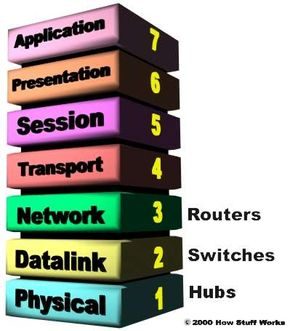
You probably already know that replacing hubs with switches can completely change the way nodes communicate. But the question inevitably arises, “What’s the difference between a switch and a router?” Very similar. They both move data. However, they work on completely different principles.
The main difference is the layer of the OSI model where they reside. Switches are usually located in layer 2 (data link layer). They make forwarding decisions based on MAC addresses. Routers work at Layer 3 level (network layer). They look at Layer 3 addresses such as IP, IPX, AppleTalk, etc. depending on the protocol stack used in your environment.
The algorithms controlling the packet forwarding logic are completely different. This distinction is important when considering how to handle certain types of traffic (broadcasts).
The Broadcast Problem
Broadcasts are not just noise. These are important for the operation of the network. When a device joins a network, it doesn’t know who’s already there. It doesn’t know the IP of the domain controller, print server, or file share. So, it shouts. It sends broadcast packets to announce its presence to the void.
Other nodes are listening. A domain server hears this shout and adds the new machine to the browser list. Think of this list as a dynamic address directory. Once the device is in the browser list, you can start communicating directly. Devices use broadcast when they need to make an announcement to an entire network segment, or when they simply don’t know specific recipients of the information.
How switches and routers handle traffic differently
Here, the hardware differences are the most important in network design.
A hub or switch receives incoming broadcast packet and floods them to all other ports in the broadcast domain. Everyone hears the shout.
Routers don’t do that.
Imagine a four-way intersection. In a simple network, traffic flows freely at intersections regardless of destination. Now imagine that the intersection is a border. For transit, you must present a passport with a specific address. You cannot just wander through. If you don’t have an exact destination address, the border guard will stop you.
Routers work just like border guards. Without a specific Layer 3 address, the router drops the packet. It will not forward the broadcast.
Why this distinction is important
This behavior keeps networks separate. This prevents a broadcast storm on one subnet from choking another. It creates boundaries. But it also creates isolation.
If you want devices on different subnets to communicate, the router blocks the initial discovery phase. If there is no specific IP address to send the “hello” packet to, the packet will not go through. It is great for security and containment. Seamless communication between different parts of the same logical network is terrible.
This is why switches and routers exist alongside routers. Switches handle local traffic, broadcast, and MAC-level forwarding within a network segment. Routers handle long distance routing between these network segments. Both are required. We need the Border Patrol to prevent chaos, and we need switches to stay in touch with our neighbors.