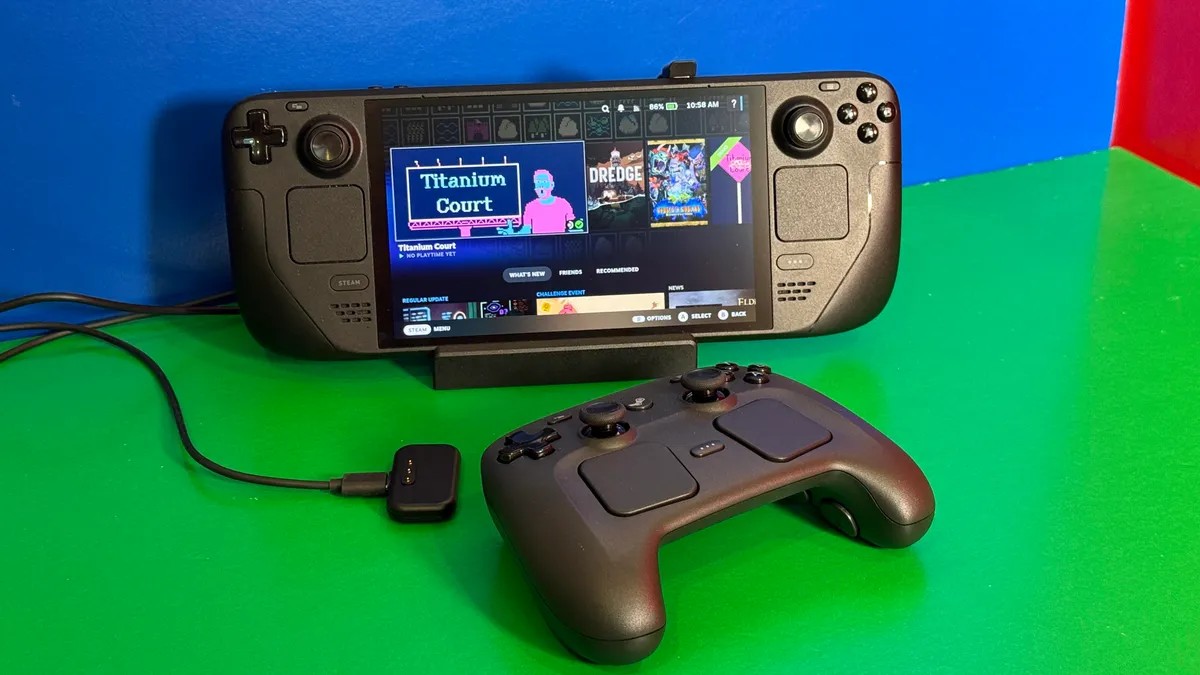
Valve’s new Steam Controller, priced at $99, has earned CNET’s Editors’ Choice award for its exceptional build quality, versatile control scheme, and seamless integration with the Steam ecosystem. While the highly anticipated Steam Frame and Steam Machine remain in development, this new peripheral offers an immediate and significant upgrade for PC gamers, particularly those looking to transform their Steam Deck into a living-room console experience.
A Familiar Yet Distinctive Design
At first glance, the Steam Controller appears to be a straightforward translation of the Steam Deck’s control layout into a standalone wireless form factor. It features dual analog sticks, a traditional D-pad, standard face buttons, and analog triggers. However, it retains two of the most distinctive features of Valve’s handheld: large capacitive touchpads on the lower half and gyroscopic motion controls for precise aiming.
The rear of the device houses two sets of clickable capacitive paddles, offering customizable inputs that enhance gameplay without requiring the player to remove their thumbs from the primary controls. Despite the presence of trackpads—a feature that often compromises ergonomics in other controllers—Valve has engineered a device that remains remarkably comfortable. The form factor is dense and slightly heavier than a standard Xbox controller, providing a substantial feel that many users find satisfying to hold.
Superior Haptics and Wireless Performance
One of the controller’s standout features is its haptic feedback system. The vibration motors deliver a wide range of sensations, from intense rumbles to subtle, nuanced clicks. Notably, the virtual clicks generated by the touchpads are also haptic, adding a tactile layer to digital interfaces that mimics physical buttons.
For connectivity, Valve includes a proprietary wireless receiver puck in the box. This small device plugs into a USB-C port (such as those on a Steam Dock) and offers a dedicated wireless channel with significantly lower latency than standard Bluetooth. This is crucial for fast-paced games; during testing with the twitch-shooter Sekiro, the responsiveness was nearly indistinguishable from playing directly on the handheld device.
Key Insight: While the controller supports standard Bluetooth pairing, the included puck provides a more stable connection. Up to four controllers can connect to a single puck, making it an efficient solution for local multiplayer sessions without cluttering USB ports.
The puck also serves a dual purpose: it acts as a magnetic wireless charger. Users can simply snap the controller onto the back of the puck to recharge it, adding a convenient layer of utility to the hardware bundle.
Why This Matters for Gamers
The release of the Steam Controller addresses a specific gap in the market: high-quality, affordable peripherals for PC gaming that prioritize versatility. While many users pair generic controllers with their PCs or Steam Decks, this device is tailored specifically for the Steam Input software, ensuring that complex remapping and gyro-aiming features work out of the box.
For Steam Deck owners, this controller effectively transforms the handheld into a true living-room console. By connecting the Deck to a TV via a dock and using this controller, users can enjoy a setup that rivals traditional consoles in comfort and functionality. Although the official Steam Dock ($79) is a separate purchase, third-party alternatives exist, allowing users to build a cost-effective living-room gaming station.
The Bigger Picture: Hardware Delays and Strategy
The controller’s release comes amid ongoing delays for Valve’s other major hardware projects: the Steam Frame (VR headset) and the Steam Machine (TV console). According to Valve engineers, these delays are partly attributed to the global semiconductor shortage (often referred to as the “RAMpocalypse”). By launching the controller independently, Valve provides immediate value to its user base while continuing development on larger, more complex systems.
Conclusion
The Steam Controller is a well-executed, versatile peripheral that enhances both PC and handheld gaming experiences. Its combination of low-latency wireless connectivity, innovative haptic feedback, and ergonomic design makes it a standout choice for the Steam ecosystem. While it may not replace traditional console controllers for everyone, it is an essential tool for anyone serious about maximizing the potential of their Steam hardware.