On May 23 in Los Angeles.
Houston Dynamo had the ball. Goalie beat. The net looked empty. Then an LA Galaxy defender kicked it away. Last second save.
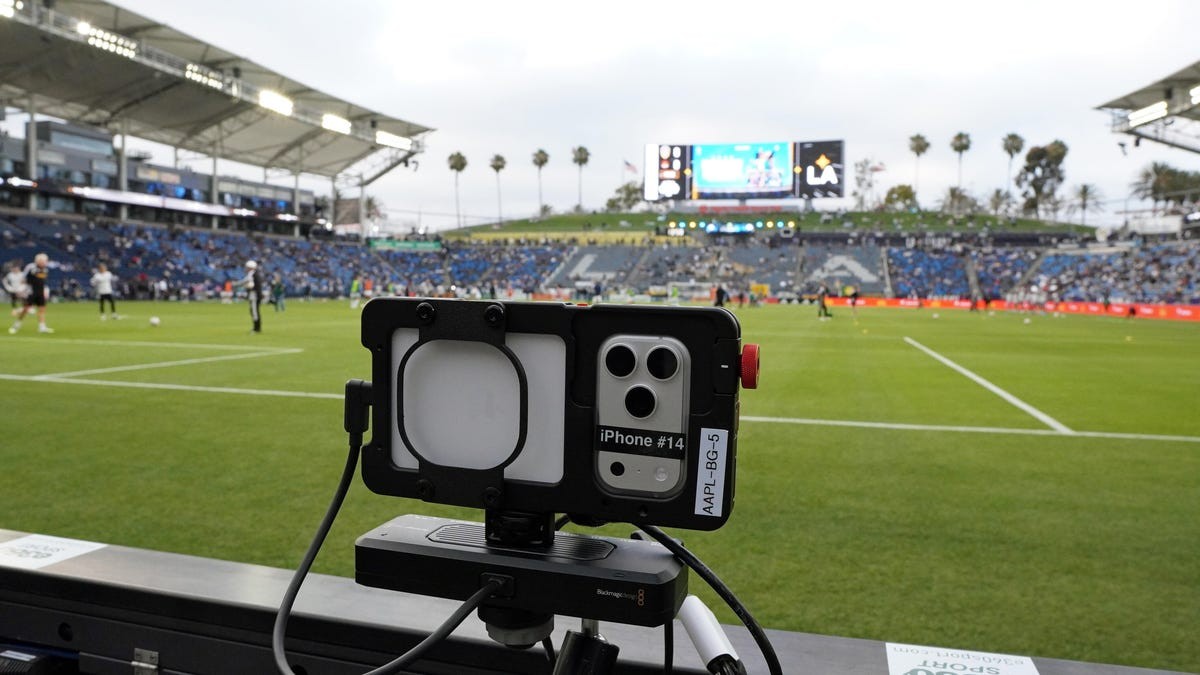
But if you were watching on Apple TV, you didn’t see that from the big tower camera. You saw it from behind the goal. From an iPhone 17 Pro Max.
For the first time in professional sports history. An entire major league game shot strictly on Apple hardware. No broadcast cameras. Just phones.
The Setup
Fifteen iPhones total.
Eight of them used the lenses already on the device. Seven used massive external zooms. These weren’t toy add-ons either. They looked like the $265,00 Fujinon Cinema Box Lens. Heavy glass. Professional glass. Mounted directly onto the phones.
Seth Bacon, MLS media exec, told the press this changes where cameras can live.
“Those bench cameras you saw… usually we can’t get that close,” Bacon said. “The compactness is a big step.”
Think about that.
Standard cameras are huge. Bulky. You can’t shove a cinema rig six feet from the sideline without risking a lawsuit or a broken nose. An iPhone is small enough to tuck right into the coach’s space. To sit behind the goalie. Places normal gear simply won’t fit.
It’s not just visuals though. The microphones are there too. But MLS isn’t letting you hear the players yet. Privacy reasons. And honestly. You probably don’t want to hear the swears used in the heat of a match. Just now. Game audio only.
Can You Replicate It?
Royce Dickerson at Apple wants you to believe yes.
“The quality is just as good,” he said. “You won’t be able to tell the difference.”
He’s half-right. The native lens footage on the iPhone 17 Pro is broadcast quality. Blazing fast. Clear. 1080p, 60 frames per second. If you had a $250k lens attached to your phone, sure. You’d match the feed.
But you don’t.
Most people won’t.
The external lenses used here? Apple didn’t confirm the cost, but if they mirror Fujinon prices, we are talking about five-figure bills for the glass alone. Then there is the workflow.
Footage goes from the phone via USB-C. To an HDMI converter. Through fiber optics. Down into the bowels of the stadium.
A guy sits in a gimbailed chair. He operates the phone like it’s a million-dollar rig. Tilts. Pans. Zooms. It moves smoothly because he knows how. It looks like any sports cam op I’ve seen. Except the brain of the operation is a phone.
Inside the Truck
I went where the magic happens.
Not the field. The broadcast center.
It’s a portable room. Hidden under the seats at Dignity Health Sports Park. Pulled in by semi. Dark. Cramped. Three rows of monitors angled toward a master wall.
Twelve people sat there. Headsets on. Eyes glued to the screen.
As the game started, the noise in the room changed. Quiet planning became frantic coordination. Switch to camera four. Cut to bench.
They spliced the fifteen iPhone feeds into one narrative. Real time.
There are delays, obviously. But the goal was minimal latency. The fiber cable does heavy lifting.
What’s strange?
The footage processing isn’t rocket science. It uses Blackmagic software. You can buy the iOS version of that app today. It costs less than a new jacket. The difference is the team of pros deciding what you see, millisecond by millisecond.
Apple says this proves your pocket has the power. You could film your kid’s game with pro quality. Technically true. The phone can do it. The sensor is fast. The code is efficient.
But the lenses. The operators. The truck.
“You’re gonna get the great broadcast quality… with a consumer readily available device,” Dickerson claimed.
He stopped short of saying it’s easy.
Maybe the quality is there. But the infrastructure isn’t. We are left wondering if we should be excited that phones can do this job. Or slightly disappointed that “professional quality” still requires a $1,000 device and a team of experts to make sense of the signal.