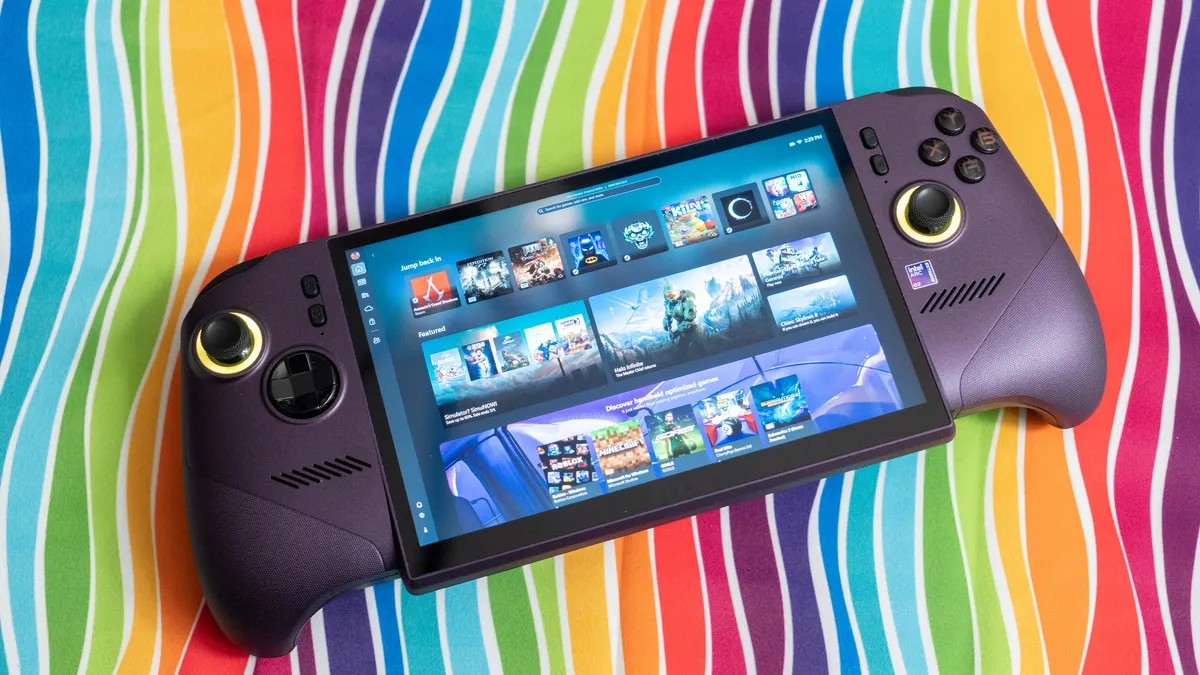
Three stories converge on this device. One is about a redesign that actually makes sense. Another is about the new Intel chip pushing hardware boundaries. The third is a familiar tragedy: Windows still drives me absolutely crazy.
The MSI Claw 8 EX sits in the arena with the Legion Go and ROG Ally X. Play Steam, Epic, GOG? Sure. But prices are soaring. Memory and chips cost more now because AI companies are buying up all the silicon, leaving gamers to pick up the tab.
The original Claw 8 launched at $799. The new EX is $1,800 that hurts.
And it keeps getting worse. There’s just one model right now. An Asus lower-tier version exists, cheaper but less potent, but MSI is charging premium pricing for a niche product with no end in sight on costs.
Pretty, purple, and sweaty
MSI changed the look. Dark purple front. Black back. The grips got extended, copying the Ally X’s ergonomic attempt at comfort.
Does it work? The texture is too aggressive. I prefer rubber. My preference, maybe, but here is the reality: it gets warm. My palms sweat almost instantly. Not ideal for a four-hour gaming session.
They’re huge, too. I wear size 7 gloves. My fingers struggle to reach the bumpers unless I hold it like I’m gripping a steering wheel in a panic. Your mileage will vary. But yeah, they’re big.
Top edge saves the day. Two Thunderbolt 4 ports, microSD, audio jack. Nothing on the bottom. Good. I hate cables digging into my stomach while I sit cross-legged.
Controls feel decent. Back buttons exist, can be remapped. Hall Effect sticks? Yes. Magnetic sensors mean no wear-and-tear on physical contacts. They are smooth. Durable. The software, MSI Center, lets you tweak everything. Dead zones. Gyro calibration. It’s standard fare for this class.
Triggers though? Deep pull. Long travel. I miss physical stops. Even at high sensitivity, the lack of resistance feels limp. Clicky buttons. Good feedback there.
It fits in the old dock. That’s nice. At least that part worked.
Fast, until it isn’t
Performance? It is the best Windows handheld I have tested. The bar is low. The truth depends on what games you play and how much you care about frame rates.
2D games? Hades 2 runs like butter. Over 100 frames per second. Everyone can handle that.
Older 3D titles shine here. Shadow of the Tomb Raider hits 66 FPS on highest settings with this Intel Arc chip. The ROG Ally X managed 43. The Arc G3 Extreme is clearly superior for older assets.
Ray tracing? Avoid AMD here. Intel wins hands down. AMD’s GPUs lag by over 60% in ray tracing tests.
But AAA modern games? The struggle begins. Assassin’s Creed Shadows. The Arc is fast. Okay, fast relative to others. 38 FPS at low settings. If that satisfies you, buy it. If not? You’re going to be mad.
Intel and MSI packed it with tricks to hide the pain. The MSI software gives you modes. AI Mode tries to guess your needs. Endurance caps frames at 30 and kills high-performance cores. Manual lets you fiddle with wattage.
It tops out at 45 watts total. The chip itself pulls 35W. In AI mode, it sits close to the max automatically. You barely need to touch settings.
Here is the weird part: performance on battery feels identical to being plugged in. Same power draw. Same frames.
Battery life itself? Terrible. Endurance mode is broken or confused. In Hogwarts Legacy, it capped frames at 30 but burned the exact same power as other modes. My battery drained 1% every ten minutes. I never saw more than three hours. Never thought “gee, this lasts.” Just empty.
XeSS? Intel’s upscaling tech with multiframe generation. I tested it in Hogwarts. Gained a few frames. Looked like wax figures. Smooth skin. Out-of-sync lips. Expressions died. It wasn’t worth it.
Settings are a pain. Changing Intel graphics settings forces a restart of the display driver or a switch to desktop mode. Every single change. It’s tedious.
The chip, Arc G3 Extreme, matches laptop specs from the Core Ultra series. Similar CPU. Slower multi-core performance because the laptop chips have two more P-cores. Handhelds always make that sacrifice.
The Screen
Expensive price. Disappointing glass.
120Hz IPS panel. Small sRGB gamut. Contrast numbers look okay on paper but reality is duller than OLED. Whites look cold, tinted blue by overdrive at brightness levels the panel can’t really support. It feels cheap next to competitors with better tech.
The OS problem remains
Windows. Still the problem.
I had the same issues on the Ally X. Same bugs here. Oh wait. Recall didn’t ask me to turn it on during setup. Small victory. Keep that one win.
Here is the list of grievances, summarized from previous rants because the industry refuses to learn:
- Inconsistent interfaces break immersion when you aren’t in the Xbox full-screen mode (which is most of the time).
- Apps glitch. Controller input drops focus. Apps swap randomly during load screens.
- Games constantly confuse keyboard for controller. Or vice versa.
- Memory management fails. The MSI utility even has a button to “Free Memory.” That is a failure state for an operating system.
- Desktop keyboard covers the text box it’s typing into.
New hate: switching modes is absurdly bad. Go back to desktop? Xbox app stays minimized or windows out. You have to manually force full-screen.
The main selling point of a Windows handheld is game choice. Play whatever is on a store. But these devices feel like they do gaming and computing, rather than being computers optimized for handheld gaming. It’s not MSI’s fault. It’s Intel’s fault. It’s Microsoft’s. But it shows up here.
I like playing in bed. No desk. No streaming lag.
The power management bugs feel like early-adopter growing pains. Or interface confusion. My brain calls a collection of interfaces a “confusion.” And these things are full of it.
Would I spend $1,800? Maybe not. Not for this screen. OLED means deep blacks. HDR that actually pops. Better colors for the games I actually play. Performance that barely crosses into “okay” doesn’t justify the price gap.
The Claw 8 looks cool. Plays better than the competition. But the screen and the OS hold it back. It feels incomplete. Like it’s waiting for software that doesn’t exist yet.