We’re living through a weird, wonderful peak in mobile photography. I just handed an Editors’ Choice to Xiaomi and Leica’s latest Leitzphone. Now Oppo is back with the Find X9 Ultra. It’s built for the same people—those of us who won’t settle for good enough.
Hasselblad helped build it. That means big sensors. Wide apertures. An optional telephoto add-on that lets the thing do some genuinely wild things. The X9 Ultra isn’t just a phone. It’s a camera bag shrunk down into your pocket.
There’s a catch, though. That Leitzphone from earlier is a heavy rival. Xiaomi’s device is more expensive, yes. But it brings real innovation. Physical control wheels. A continuous zoom lens that actually moves. The Leitzphone is still my favorite for “ultimate” phone cameras.
The X9 Ultra is close, though. Very close.
But here’s the thing.
Great images don’t just happen with this phone. They have to be fought for.
Getting the best shots requires a manual touch. You need to think at the shutter release. Then you need to work in editing afterwards.
Let’s talk money before we dive deeper. It costs £1,449 in Europe. That makes it competitive against the £1,700 Leica phone. It isn’t coming to the US officially. Do the math if you need to—that’s roughly $1,950.
Camera: The Raw Deal
Look at the back. It’s a hardware festival. A 200-megapixel shooter leads the pack. A 50MP ultrawide sits beside it. Then you get the telephones: one at 200MP for 3x optical, another 50MP unit for 10x. Impressive numbers.
I’ve shot hundreds of photos. Most look fine on their own.
Bright. Crisp. Saturated. But also? A little cold. That’s the default setting doing the talking. My eyes register a magenta cast whenever I let the auto settings take the wheel. It kills the warmth of sunny days.
When I switched to Master Mode. Everything changed.
Manual white balance brought the green tint back where it belonged. The resulting shot felt like I had taken it, not the algorithm. Almost every photo I loved came out of that mode. I also shot in DNG RAW. It gives Adobe Lightroom plenty to work with.
Straight out of the camera? The RAW file starts strong. Even exposure. Accurate colors. A few tweaks in post. Suddenly you’re looking at an image that stands next to shots from my Leica Q3 or Canon R6 without apology.
The phone helps capture the base. But you have to finish it.
Oppo’s automatic JPEG processing? Not my favorite. It raises shadows until they’re flat. It sharpens until skin looks like plastic. It’s that “Android look.”
Shoot in RAW Master Mode, and the phone stops meddling. The benefits are immediate. Compare the two. One is a drab sunrise flattened by software. The other has drama. Gold pouring through the trees.
The ultrawide lens is the worst offender here. Default mode pushes processing too hard. Take control, and the image opens up.
Is it harder than the Xiaomi? Yes. Much. With the Leitzphone I’d use Leica profiles—Chrome. High contrast B&W—and hit save. No editing needed. The X9 Ultra offers some filmic styles too. They look cheap. Like filters from a free app on the Play Store.
Hasselblad doesn’t usually bother with these tricks in its pro gear. Nor does it offer a simple mono mode in the X2D or 907X cameras. Fujifilm gets it right. They give you dials to adjust the look. Oppo seems to just slap presets on the wall. I wouldn’t buy this phone for the filters.
I’d buy it for the zoom.
Zoom: Telescope Mode
The phone ships with two tele lenses. One 3x. One 10x. That 10x lens is pin sharp on stationary subjects. It compresses space nicely. Creates intimacy.
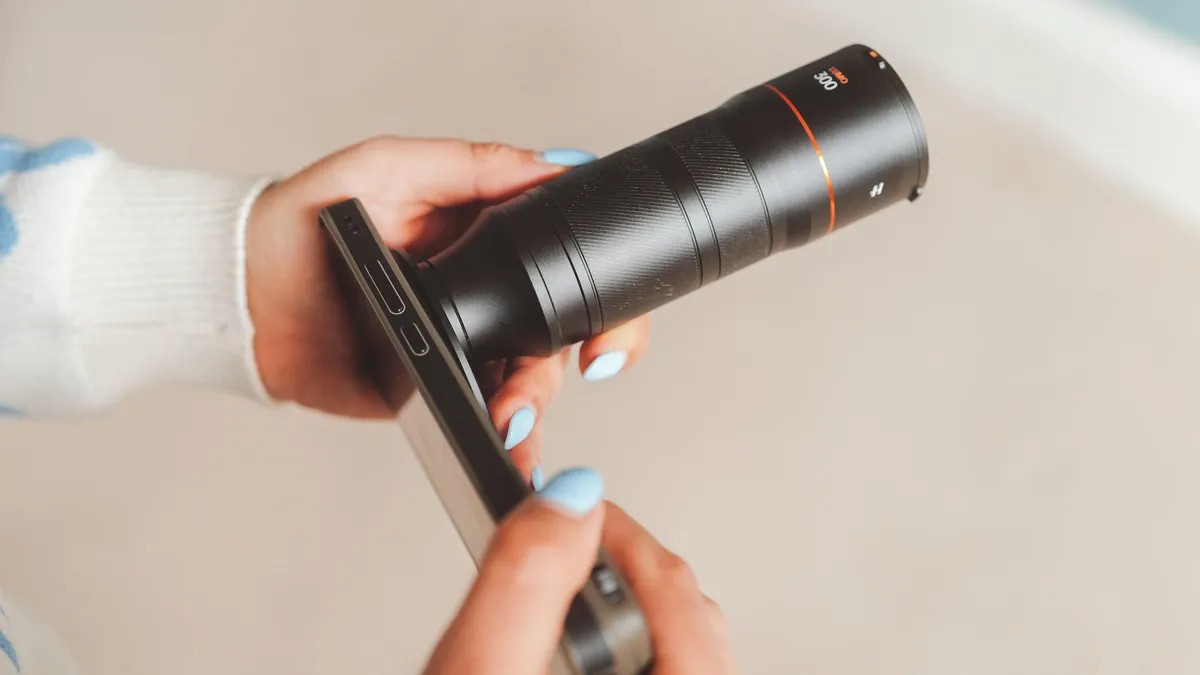
Attach the optional add-on lens to that 3x sensor, however? Chaos ensues.
The add-on turns the phone into a spotting scope.
I pointed it at a docked cruise ship. Ultrawide sees nothing. Add-on lens? I could see the paint chipping off the lifeboats.
I got a cool shot of a cable car against rough rock. You couldn’t have done that without the add-on. It’s impressive.
Is it perfect? No.
The base 13x zoom feels restrictive. The 30x and 60x digital crops? Painful.
I went dolphin spotting. From a bouncing boat. The results were mixed. Lots of empty water. Maybe a fin. Hardly Wildlife Photographer of the Year material. I managed one decent shot, but only after dozens of fails. The zoom range fights you if you aren’t standing still.
Then I pointed it at Funchal in Madeira. Suburban sprawl turned into geometric steps by extreme magnification. A genuinely impressive capture.
But consider the trade-offs. The lens is big. Heavy. Needs a special mount and case. Awkward to carry. Digital upscaling eats detail at 60x. Instagram will forgive you. A gallery wall might not.
Worst part? You lose control. The add-on locks you out of RAW and manual white balance. You can only shoot in a specific zoom mode. And the price? Another £499 on top. Nearly $675. That’s steep for an accessory you’ll likely use for three shots a month.
It comes as part of the Explorer Kit, which bundles a grip.
Grip It If You Can
The handle helps. It makes the phone feel like a compact camera. Especially with the massive lens attached. But I prefer Xiaomi’s grip solution. Why? Theirs attaches via USB-C. Independent of the case. Adds battery. Clips off easily when done.
Oppo’s grip needs its own charge. It talks Bluetooth. You have to pair it. Unpair it. It’s one step too many.
The Final Tally
The X9 Ultra looks stunning. Metal and leatherette. Clear echoes of Hasselblad’s pro cameras. That orange button on the side mimics the shutter perfectly. IP69 rated. Rain won’t stop the shots.
It loses out on technicals, though. Xiaomi uses a larger sensor with new LOFIC tech for better dynamic range. Oppo relies on HDR blending to catch up. It feels like Xiaomi is pushing harder on hardware.
That physical control wheel on the Leitzphone matters too. So does the continuous optical zoom that moves real glass. Those things help street photographers.
The Oppo X9 Ultra? It’s powerful. Yes. But it wants you to be a photographer first. A tech consumer second. You need to care about RAW files. You need to not mind the extra weight of accessories. Or the cost of them.
Will I be editing more?
Absolutely.
Does it get in the way when you just want a quick snap?
Probably. But sometimes that’s the point, isn’t it. Sometimes the friction is part of the craft. I just wish the tool felt a bit more elegant in doing it. The lens stays in my bag. The editing happens in the studio. The results? Well. They’re good enough to ignore the price tag. Mostly.