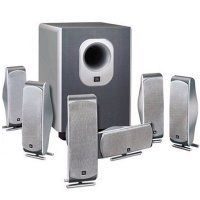
You can spend a fortune on audio gear. Top-tier amplifiers. High-resolution storage. Premium cabling. It all amounts to garbage if your speakers are cheap. The speaker is the final boss of any audio chain. It is the only part that actually creates the sound you hear. Everything else is just preparing the signal.
Speakers are cultural icons. We have lived with them for over a century. Yet, their inner workings are shockingly simple. They take an electrical signal and turn it back into physical motion. That motion moves air. That moving air hits your ear.
It is a reverse engineering process. A microphone captures sound. It turns air pressure into electricity. You store that electricity on a disc or tape. When you play it back, an amplifier sends that electricity to the speaker. The speaker must then mimic the original air pressure changes. If it fails, the sound is bad. Period.
The Physics of Hearing
To get how speakers work, you have to understand sound itself. It is not magic. It is physics.
Inside your ear lies a thin membrane. The eardrum. When air pressure hits it, it vibrates. Your brain translates that vibration into sound. Most of the time, air is the medium. Sound travels through liquids and solids too, but speakers rely on air.
Think of a bell. Ring it. The metal flexes. In and out. Fast.
When the metal pushes out, it shoves the air molecules in front of it. Those molecules shove the next ones. The chain reaction continues. It is a pulse. A traveling disturbance.
When the metal pulls back, it creates a vacuum. A drop in pressure. This is called rarefaction. The surrounding air rushes in to fill the gap. This pulls on the air further out. The cycle repeats.
The result is a wave of pressure fluctuation. It moves through the atmosphere. It hits your eardrum. Your brain says “sound.”
Pitch, Volume, and Waves
Not all sounds are equal. Your brain distinguishes them based on two variables.
First is frequency. This is how fast the air pressure fluctuates. High frequency means fast fluctuations. You hear this as high pitch. Low frequency means slow fluctuations. You hear this as low pitch.
Second is amplitude. This is the strength of the air pressure change. Stronger waves move your eardrum harder. You register this as higher volume.
A microphone captures these exact variables. It has a diaphragm that vibrates with the sound waves. It converts that physical motion into an electrical signal. The signal gets encoded onto a CD, tape, or digital file.
When you play it back, the speaker reverses the process. It takes the electrical signal. It creates physical vibrations. It moves the air. A good speaker reproduces the original air pressure fluctuations with high accuracy.
The Speaker Driver
The speaker is the final translation machine. It is the reverse of the microphone. It takes the electric current from the amplifier and turns it into physical movement.
Traditional speakers use drivers to do this. A driver is the core component. It is where the electricity meets the air.
But how does a driver move air? It starts with a diaphragm.
The Mechanics of Movement
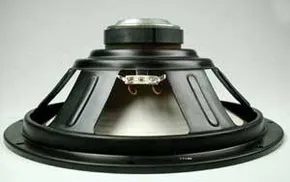
Sound starts with vibration. A driver forces a diaphragm or cone to oscillate rapidly, pushing air molecules to create pressure waves we hear as audio. The cone itself is typically constructed from paper, plastic, or metal materials. It connects to the suspension, also known as the surround, at its wide outer edge. This rim allows the cone to flex. The suspension anchors the cone to the driver’s metal structure, known as the basket.
At the narrow end of the cone sits the voice coil. This coil rests on the spider, a flexible ring that keeps the coil centered. The spider permits free back-and-forth movement while maintaining alignment. Some designs replace the cone with a dome. A dome extends outward rather than tapering inward, serving the same diaphragm function.
How the Voice Coil Generates Sound
The voice coil is the engine of the driver. It consists of wire wrapped around a former, attached to the cone or dome. When an electrical audio signal passes through the coil, it creates a magnetic field. This field interacts with a permanent magnet fixed to the basket. The interaction pushes or pulls the coil, moving the attached diaphragm.
This process converts electrical energy into mechanical motion. The voice coil ’s placement within the magnetic gap determines efficiency and linearity. Thicker wire handles more power but adds mass. Thinner wire moves faster but risks overheating. The spider and surround control the coil’s range of motion, preventing damage from over-extension.
Why Driver Components Matter for Audio Quality
Each part influences sound characteristics. The cone material affects rigidity and breakup frequencies. Paper offers natural damping. Plastic provides consistency. Metal offers stiffness but can resonate. The suspension compliance impacts low-frequency response. A softer surround allows deeper bass. The spider ’s stiffness affects midrange clarity.
The voice coil design dictates power handling and thermal stability. A larger coil can dissipate heat better, allowing higher volumes without distortion. The dome design often improves high-frequency dispersion compared to cones. It reduces directional beaming. This matters for stereo imaging and off-axis listening.
Where Component Choices Impact Everyday Listening
Consumer headphones and speakers use these principles differently. In-ear monitors often employ dynamic dome drivers for compact size. Bookshelf speakers might use paper cones for warmth. Subwoofers rely on heavy voice coils and robust suspensions to move large air volumes. The basket material also plays a role. Aluminum baskets reduce resonance compared to steel.
Understanding these components helps explain why certain speakers sound “bright” or “warm.” A stiff cone might emphasize treble. A compliant surround might boost bass. The voice coil inductance affects high-frequency roll-off. These details matter when choosing equipment for specific listening environments.
How to Evaluate Driver Specifications
Manufacturers often omit spider and surround details in basic specs. Look for Thiele-Small parameters for deeper insight. Qms indicates suspension losses. Qes relates to voice coil damping. Qts combines both. Low
The Physics of Pulse
Flip the current. The polarity flips. Simple as that.
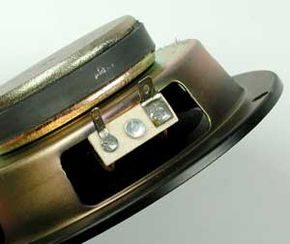
A voice coil is just an electromagnet in disguise. It’s wire wrapped around magnetic metal, usually iron. Run electricity through it, and you generate a field. North becomes south. Reverse the flow, and they swap places instantly. This isn’t magic. It’s basic physics.
Stereo signals do exactly this. They reverse the flow of electricity constantly. You see the wires? Red for positive. Black for ground. The amplifier isn’t just pushing current one way. It’s fluctuating. Positive charge. Negative charge. The electrons don’t just drift. They oscillate. This alternating current forces the electromagnet’s poles to switch positions many times a second.
Magnetic Push and Pull
Why does the coil move?
It’s not floating in a void. The voice coil sits inside a constant field created by a permanent magnet. Think of it as a standoff. Two magnets facing each other.
When the electromagnet’s polarity matches the permanent magnet’s negative pole, it attracts. When it flips to positive, it repels. The alternating current keeps switching this dynamic. Attraction becomes repulsion. Repulsion becomes attraction. The voice coil acts like a piston. It’s shoved forward. Then pulled back. Rapidly.
This mechanical movement pushes air. Vibrations create pressure waves. Those are sound waves.
The electrical signal is itself a wave. Frequency. Amplitude. These numbers dictate how far and how fast the coil moves. Fast movement. High frequency. Loud movement. High amplitude. The diaphragm copies the electrical wave’s shape in air.
Driver Types
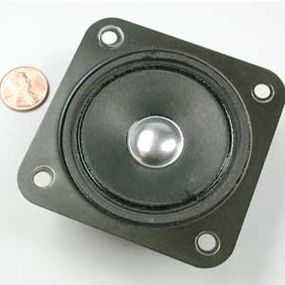
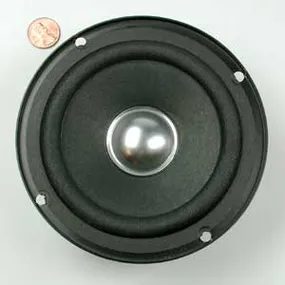
Think about how sound actually moves through the air. Traditional speakers work by pushing and pulling an electromagnet attached to a flexible cone. The physics don’t change, but the hardware does. You get everything from tiny units to massive cones, all trying to do the same job: move air.
The industry splits these basic driver types into three main categories because one size really doesn’t fit all.
- Woofers handle the low end.
- Tweeters take care of the highs.
- Midrange drivers sit in the middle.
It’s not just about marketing. It’s about physics. To create high-frequency waves, the diaphragm has to vibrate incredibly fast. The points of high and low pressure are squeezed tight together. A large cone has too much mass for that. It’s like trying to twitch a heavy blanket quickly. You can’t. It’s clumsy.
Conversely, getting a small driver to move slowly enough for deep bass is equally frustrating. Small cones are built for rapid movement, not sluggish, heavy lifting. That’s why you rarely see a single driver doing everything perfectly.
Handling Different Frequency Ranges
When you try to force one cone to do it all, you compromise. If you size it for bass, the highs get muddy. If you size it for treble, the bass feels thin and weak.
That’s why most decent audio systems use multiple drivers. The woofer is usually the largest unit, built to displace enough air for those rumbling low frequencies. The tweeter is a much smaller unit, designed specifically to produce the highest frequencies without distorting. Then there’s the midrange speaker. It fills the gap, producing the bulk of human speech and most instruments.
This division of labor means each driver operates in its “sweet spot.” The woofer isn’t trying to hit a cymbal crash. The tweeter isn’t trying to shake your floorboards. They split the workload.
“To create higher frequency waves, the driver diaphragm must vibrate more quickly.”
But splitting the signal isn’t enough on its own. You need a way to tell each driver exactly which frequencies to play. That’s where crossovers come in. Without them, the tweeter might try to play a bass note and blow out. The woofer might attempt a high hat and sound terrible.
The system needs to route the right frequency range to the right hardware. It’s a simple concept, but getting it right is what separates a tinny phone speaker from a home theater system that actually makes you feel the explosion.
We’ve established why we need separate parts. But how do those parts actually talk to each other? And what happens when they disagree on where the signal should split?
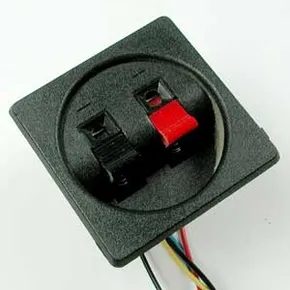
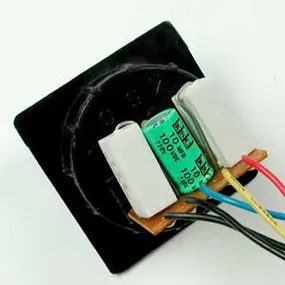
Quality audio demands precision. To reproduce sound across a wide frequency range effectively, you cannot rely on a single driver to do everything. Instead, the spectrum gets broken into smaller chunks. Specialized drivers handle these specific tasks. High-end loudspeakers typically include a woofer for bass, a tweeter for treble, and sometimes a midrange driver for vocals and instruments. All of these components live inside one enclosure.
But how do you ensure the low notes don’t muddy the high notes? The system must split the audio signal first. This is the job of the speaker crossover.
The Mechanics of Passive Crossovers
The most common type is the passive crossover. It requires no external power. The audio signal activates it as it passes through. Inside, you will find inductors, capacitors, and other circuitry. These components only conduct electricity well under specific conditions.
Capacitors are tricky. They conduct current easily when the frequency exceeds a certain threshold. Below that level? They block it. Inductors work in reverse. They conduct well only when frequencies are low.
When the electrical signal travels through speaker wire, it hits the crossover units. To reach the tweeter, current must pass through a capacitor. High-frequency signals flow on to the tweeter voice coil. Low frequencies get filtered out. For the woofer, current passes through an inductor. The driver responds mainly to bass.
A midrange driver gets a more complex path. The crossover uses both a capacitor and an inductor. This sets an upper and lower cutoff point. It isolates the mid-range frequencies precisely.
Active Crossovers: Precision at a Price
There are also active crossovers. These are electronic devices. They split the frequency ranges before the signal hits the amplifier. You need a separate amplifier circuit for each driver.
Why choose active over passive? Control. You can easily adjust frequency ranges with active units. Passive crossovers are fixed. Their ranges are determined by the physical components. To change them, you must swap out capacitors and inductors. It is a hardware change, not a software tweak.
Active crossovers aren’t ubiquitous, though. They cost significantly more. You also need multiple amplifier outputs for your speakers. The barrier to entry is high.
Why Enclosures Matter
Crossovers and drivers can be installed separately. But most consumers buy speaker units that house the crossover and multiple drivers in one box. This integration simplifies setup. It also affects sound.
The enclosure itself plays a massive role. It influences resonance, bass response, and overall tonal balance. A poorly designed box can ruin even the best driver.
In the next section, we’ll find out what these speaker enclosures do and how they affect the speaker’s sound quality.
Sealed Speaker Enclosures
Speaker enclosures do more than just look neat. They are critical components that dictate how a speaker performs. Without them, a driver is just a loose cone on a table, vibrating every surface it touches. This causes muddy, distorted audio.
Most systems house drivers and crossovers in one unit. This makes setup easier. The drivers stay in position. They work together. But the real magic is in the box itself. Heavy wood or solid materials absorb vibration. If the cabinet shakes, it drowns out the music.
The enclosure also manages sound waves. Drivers push air forward. They also pull it backward. The box handles the backward wave. Different designs handle this in different ways.
Sealed Enclosures Explained
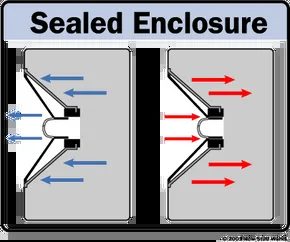
Sealed enclosures are also known as acoustic suspension enclosures. They are completely airtight. No air escapes.
The forward wave moves into the room. The backward wave stays inside the box. As the driver moves, internal air pressure changes. When the cone moves in, pressure increases. When it moves out, pressure decreases.
This creates a constant pressure difference. Air always seeks to equalize pressure. So, the driver is pushed toward its resting state. Internal and external pressures match at rest.
This design is less efficient. The amplifier must work harder. It boosts the signal to overcome air pressure force. But that force is useful. It acts like a spring. It keeps the driver in the right position.
The result is tight, precise sound. Bass is controlled. Transients are fast.
Other Speaker Enclosures
How Ported Enclosures Boost Efficiency
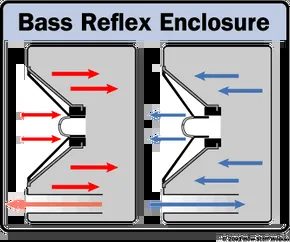
Speaker cabinets don’t just hide the drivers. They shape them. Most boxes are sealed tight. But some designs take a different approach. They redirect inward pressure outward. This extra push supplements the forward wave. It’s a clever trick.
The standard method involves a small port. You see them everywhere. That hole in a bass guitar amp. The slot on a computer speaker. These are bass reflex speakers. They use that port to let the backward motion of the diaphragm escape. The result? Sound waves shoot out of the opening. This boosts the overall volume.
The real win here is efficiency. Think about the energy. The power moving the driver doesn’t just create one wave. It creates two. One from the front. One from the port. You get more sound for the same electrical input. It’s a math problem solved with holes.
But efficiency has a cost. Precision takes a hit. In a sealed box, air pressure acts like a spring. It snaps the driver back into place after each movement. Bass reflex enclosures lack this pressure difference. The driver isn’t sprung back as tightly. Sound production becomes less precise. It’s looser. Less controlled.
So you trade accuracy for volume. A fair trade for many. Especially when you want to hear the bass kick harder without cranking the amp to eleven.
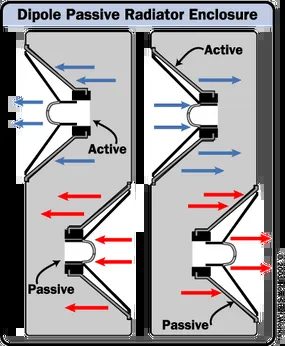
Speaker boxes aren’t one-size-fits-all. Most people know about sealed boxes and bass reflex ports, but there’s a whole other side to acoustic engineering that doesn’t rely on a hole in the cabinet. Enter the passive radiator enclosure, a design that swaps the traditional port for a second driver.
It looks like a speaker. It moves like a speaker. But it doesn’t get a signal.
In a passive radiator setup, the rear wave from your main (active) driver doesn’t escape into the room through a tube. Instead, it hits a “passive” cone. This unit has no voice coil. It has no magnet. It isn’t wired to your amplifier. It is purely mechanical, pushed and pulled by the air pressure generated by the active driver in front of it.
Why bother with this complexity? Because it offers a different kind of performance. These enclosures are generally more efficient than sealed boxes, meaning you get more bass for your energy. But they are also more precise than standard bass reflex models. The port in a traditional reflex box can sometimes cause turbulence or “chuffing” at high volumes. A passive radiator avoids that noise floor. It’s tighter. It’s cleaner.
There is a catch, though. Passive radiators require careful tuning. If you get the mass of the suspension wrong, the bass can get muddy or, worse, the cone can slap against its limits and distort badly.
The Dipole Difference
Then you have the oddballs. The dipole design.
In this configuration, you have an active driver pushing sound forward and a passive (or sometimes active) driver pushing sound backward. They face opposite ways. The result isn’t just more bass. It’s omnidirectional dispersion.
This isn’t just about filling a room with noise. It’s about how that noise interacts with the walls. Dipole speakers create a wide, diffuse sound field. They don’t project a narrow beam like a cone. They wash the room in sound.
This makes them ideal for specific scenarios. Specifically, the rear channels in a home theater setup. You want immersion, not localization. You want the surround effects to feel like they’re coming from everywhere, not just from a box in the corner. Dipole speakers do exactly that. They create a spacious, enveloping backdrop that makes movies feel bigger than the screen.
Why the Shape Matters
You might think a speaker is just a speaker. It’s not. The box dictates the physics of the low end.
Sealed boxes are simple. They roll off gently. They’re accurate but can lack punch in small sizes.
Bass reflex boxes use a port to extend the low end. They’re efficient but can be unpredictable.
Passive radiator systems offer a middle ground. High efficiency without the port noise. High precision without the sealed box’s roll-off.
And then there are the weird ones. The dipoles. The transmission lines. The horn-loaded designs. Each solves a different problem. Each sacrifices something to gain something else.
If you’re building a system, or just trying to understand why your subwoofer sounds different from the bookshelf speakers, look at the box. Look at the drivers. Look at how the air moves.
The sound starts long
Why Electrostatic and Planar Magnetic Speakers Are Niche
Traditional dynamic drivers dominate the speaker market, but they aren’t the only game in town. Several alternative technologies exist, each with distinct advantages and significant compromises. This is why you rarely see them as standalone solutions. Instead, they often work in tandem with conventional driver units to fill specific gaps in frequency response.
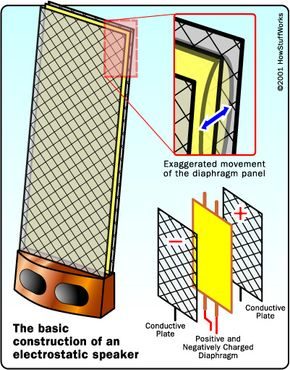
The most common alternative is the electrostatic speaker. These units don’t use a cone. They vibrate air using a large, thin, conductive diaphragm panel. This panel hangs suspended between two stationary conductive panels. Both stationary panels are charged with electrical current from a wall outlet. This setup creates an electrical field with a positive end and a negative end. The audio signal runs a current through the suspended diaphragm. It rapidly switches between a positive charge and a negative charge. When the charge is positive, the panel is drawn toward the negative end of the field. When it is negative, it moves toward the positive end.
The result is extremely accurate sound reproduction. The diaphragm has such low mass that it responds with lightning speed to changes in the audio signal. Clarity is exceptional. There is a catch, though. The panel doesn’t move a great distance. It struggles to displace enough air for deep bass. This makes electrostatic speakers ineffective at producing lower frequency sounds. You usually need a woofer to handle the low-end frequencies. Another issue is placement. Because they must be plugged directly into a wall outlet, they are harder to position freely in a room.
How Planar Magnetic Drivers Differ
Then there is the planar magnetic speaker. These units take a different approach. They use a long, metal ribbon suspended between two magnetic panels. The operation mirrors electrostatic speakers closely. The alternating positive and negative current moves the diaphragm. Instead of an electric field, this movement happens in a magnetic field.
The performance profile is similar. Planar magnetic speakers produce high-frequency sound with extraordinary precision. They are fast and detailed. But like their electrostatic cousins, they struggle with low frequencies. The bass response is less defined. Because of this limitation, planar magnetic speakers are usually used only as tweeters. They handle the highs while another driver manages the bass.
The Enduring Dominance of Dynamic Drivers
Both electrostatic and planar magnetic designs are gaining traction among audio enthusiasts. You can hear them in high-end home theater setups. They appeal to listeners who prioritize transient response and imaging. However, traditional dynamic drivers remain the most prevalent technology. Far and away.
You will find them everywhere. Not just in stereo setups. They are in alarm clocks. Public address systems. Televisions. Computers. Headphones. Tons of other devices. The simplicity of the dynamic driver concept is part of its success. It is cheap to manufacture. It is rugged. It handles a wide range of frequencies when designed well. It has revolutionized how we consume audio in the modern world.
Why do we still rely on a cone and a magnet for so many applications when flat-panel tech exists? Because for most people, good enough is good enough. And dynamic drivers are undeniably good enough.
For more information on speakers and related topics, check out the links that follow.
Lots More Information
Related HowStuffWorks Articles
-
How Amplifiers Work
-
How Hearing Works
-
How Radio Works
-
How Electromagnets Work
-
How Inductors Work
-
How Capacitors Work
-
How Analog and Digital Recording Works
-
How CDs Work
-
How DVDs and DVD Players Work
-
How Guitars Work
-
How Movie Sound Works
-
How THX Works
-
What is a decibel, and what is the loudest sound I can listen to before it hurts my ears?
More Great Links
-
AudioVideo101: Speakers
-
Secrets of Home Theater and High Fidelity
-
ElectronixWarehouse: What’s a Crossover?
-
Car Audio: How Do Speakers Work?
-
AudioWorld.com
-
SoundStage! Audio Magazine
-
Stereophile Magazine