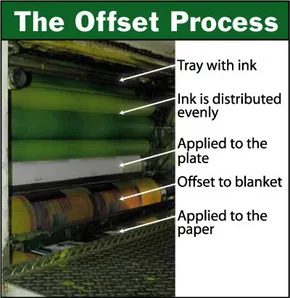
It’s fast. It’s chaotic. And it relies on a simple chemical trick to keep the ink where it belongs.
In offset lithography, the image area of the plate is hydrophobic, i.e. it repels water, but attracts oil-based ink. The non-image areas are hydrophilic and attract water while repelling ink. This creates a precise border. Ink rollers apply ink to image areas. Water rollers keep the rest of the plate clean.
The plate never touches the paper. This is the “offset” part. Instead, the color is first transferred to the rubber blanket. The blanket is then pressed against the paper, leaving the final image. This indirect method protects the delicate plate and enables higher speeds.
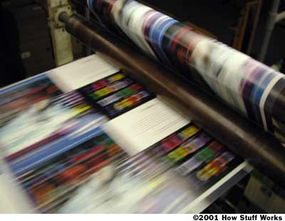
The paper comes out damp. It carries both ink and water. Smudging is a real threat if left unchecked. To solve this problem, the sheets pass through a gas-heated oven. The heat sets the ink quickly. Temperatures inside the oven range from 350 to 400 degrees Fahrenheit (176 to 206 degrees Celsius).
Why heat? This is because water and oil do not mix, but they need time to settle. The oven forces the ink to dry before the next sheet covers it. Without this step, your newspaper would be a blur.
The process is mechanical. It’s physical. And it still works despite the digital age.
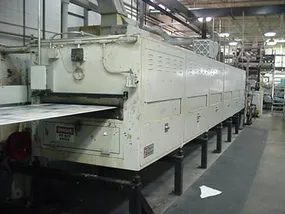
As soon as the sheet leaves the heating zone, it does not stay still. It is immediately pushed into a tight set of heavy metal rollers. These are not just any rolls. The chilled water flows through their cores, acting as an immediate freezing trap for the paper. This is the Chill Rollers stage.
Why is this important? Because the ink is still wet. Hot, sticky and ready to smudge. If the paper stays hot, the fresh ink will lift off and coat your fingertips as soon as you touch the page. Cold rolls lower the temperature immediately. They solidify the ink in the paper fibers. No more smudges. No more transfers.
But cooling is only half the battle. The real magic comes from matching colors.
Locking Down Color Accuracy
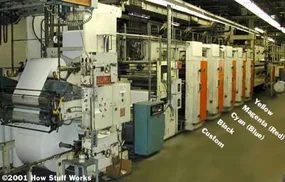
Modern presses don’t just guess at alignment. They use computers to monitor registration which is just a fancy word for how well the different color plates are aligned. Each plate handles a specific color—cyan, magenta, yellow, or black. If these plates are out of step by even a millimeter, the result is an indistinct mess. The picture looks blurry. The colors blend into each other in the wrong places. It looks cheap.
So how do they keep it sharp?
Small registration marks are printed on the edge of the sheet. A high-speed camera monitors these markings in real time. The computer sees them. It calculates an error. The position of each plate is then adjusted. This is not slow manual tweak. This happens dozens of times per second as the press processes hundreds of sheets per hour.
The system is constantly correcting itself. In one second, the cyan plate is slightly high; the next, the computer will push it down. When the sheet reaches the output tray, every color is locked in place. Perfect alignment. Clean edges.
It’s a balance of heat, cold and digital precision. If any part is wrong, the entire print job is ruined. But when it’s working, you hardly notice the machinery. You only see the color.
Ink Density and Plate Synchronization Mechanisms
It starts with registration. If the plates are not aligned, the colors will bleed into a muddy mess. This is color control in its simplest form – precise control of the interaction of ink layers on a page. But it’s not just about alignment. It’s all about volume.
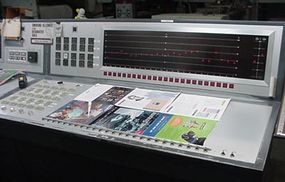
Press operators do not guess the amount of ink. They calculate it. The system needs to know exactly how much pigment it needs to release to achieve a specific visual goal. Too little and the image looks washed out. Too much, and there will be problems with trapping or drying. This setting is done directly from the control panel, which is part of a larger console that monitors the entire machine. It is a direct link from human intuition to mechanical performance.
However, modern presses do not rely only on the user’s eyes. Before the plates even touch the rollers, they go through a scanning process. A digital display is created that trappings the exact density and dot gain characteristics of the image. This data is loaded onto a micro cassette. Think of this cassette as the master file of the run.
Once the plates are installed, the press reads the cassette. No need to wait for the user to turn one knob after another. It automatically adjusts the ink keys to the preset values obtained from this scan. This ensures consistency from the first sheet to the ten thousandth. This digital handshake combines plate registration and ink delivery. No more guessing. Only data-runn precision.
The previous episode left us halfway. We talked about tools. Now let’s talk about the trap.
Software is not just code. It’s a contract you didn’t read.
You click “I accept”. You get a function. You lose your privacy.
The hidden costs of “free”.
Why do these platforms appear to be free? The answer is never free.
Data is currency. Your attention is the product.
Think about your last search. What did you type? Where did you click? These clicks are sold. Often in real-time auctions.
This is not a conspiracy. That’s business model 101.
You are not a customer. You are inventory.
How surveillance works (without you knowing)
It starts with permissions.
- Location information
- Contact lists
- Microphone permission
The weather app does not need your contact information. The flashlight app doesn’t need your location.
Still they ask. And you say yes. Because the alternative is not to use the app.
That’s the friction. The design choice makes privacy difficult.
You assume that the data remains on the device. That is not the case.
It goes to the servers. In different countries. According to different laws.
Why privacy policies are useless
Read one. Continue.
It has 40 pages of legalese. Nobody reads it.
The policy states that they collect “non-essential information”. What does that mean?
This is data that is not needed for core functionality. But required to create a profile.
Your political views. Your health interests. Your sexual orientation.
All inferred. All saved.
A profile is created from this information. Your digital twin.
Sellers buy this profile. Advertisers buy this profile.
You get nothing in return. Just a targeted ad for the shoes you looked at once.
Which apps are really safe?
There is no such thing as a perfect app. But there are better options.
Look for open source software. The code is displayed. Verifiable.
Check if the application is end-to-end encrypted. Messages remain between you and the recipient. No server.
Avoid apps that require excessive permissions.
If a calculator asks for your location, delete it.
The real solution?
You cannot refuse completely.
The Internet is based on surveillance.
But you can opt out partially.
- Use a browser that blocks trackers
- Install an ad blocker
- Disable location services for non-essential apps
- Use a search engine that doesn’t create a profile for you
It’s boring. It’s annoying. It’s difficult.
But this is the only way to keep a shred of autonomy.
Companies continue to press. Functions improve. Costs are increasing.
Will you keep clicking agree? Or start reading?
The choice is yours. Even if it feels like there isn’t one.