The state of #VirtualReality: Why gear is more important than advertising
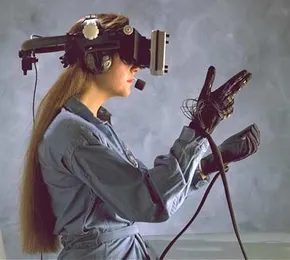
Remember the early 1990s? When you do this, you probably think of bulky headphones and bulky power gloves. Magazines, Toy stores and movies sell high-tech but clumsy versions of virtual reality (VR). It’s a fantasy of a future that feels far away.
Now the initial enthusiasm has subsided. Other areas of technology are also making progress. VR devices look pretty similar. But don’t be fooled. The field is moving. It just doesn’t move quickly. Progress often comes from the side. Military projects led to some of the progress. Entertainment can motivate others. Investors are unlikely to invest in virtual reality unless it first serves another industry.
What exactly does VR need to work? It depends on how you define “virtual reality”. If you’re not sure about this definition, a standard computer with a monitor and mouse also counts. Most researchers disagree. True VR requires immersion. Flat screens can be distracting. It breaks the illusion. So the system needs a better screen. It also requires a feeder. Keyboard and mouse are common. Joysticks are often seen. Joysticks have become the standard for interaction.
This article describes VR devices in detail. Let’s look at the types. Let’s compare the pros and cons. Let’s start with the most obvious hardware.
Head mounted display case
Head-mounted display (HMD) is a representative of VR. They placed the screen directly in front of them. This prevents the real world. It forces people to focus. It creates a sense of presence. But they are not perfect. Let’s see why these are important and where they are lacking.
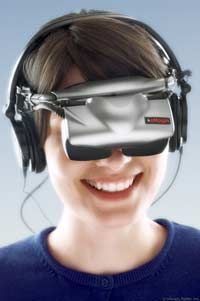
A head mounted display (HMD) is exactly what the name suggests. I have a computer screen attached to my face. Located inside the helmet or goggles. The goal is simple. No matter where you turn your head, the screen stays in your line of sight.
Most units have shared visions. One screen for each eye. This separation creates the illusion of depth. It tricks the brain into thinking that images have dimensions.
Battle between LCD and CRT
The screen inside these headphones is usually a liquid crystal display (LCD). You may find older models that use cathode ray tube (CRT) technology. The industry has changed with LCDs winning by almost every metric. It’s light. It takes up less space. It also consumes less power. Manufacturing costs are lower.
The CRT has two cards that can be played. Improved resolution. Higher brightness. that’s it.
But CRT physics doesn’t work well with the human brain. It’s big. It is very heavy. If you’re trying to use a CRT HMD, you’ll need a suspension to avoid breaking your neck. The device restricts movement. Restricting movements breaks immersion. You lose your sense of being in the world and start feeling like you have a brick on you.
Fuzzy display technology
Some engineers have experimented with other display types. They are rare for good reason. The list includes:
- Electroluminescence display
- Electrophoretic display (EP)
- fiber optic display
- Field emission display (FED)
- Light emitting diode (LED) display
- plasma screen
- Vacuum fluorescent display (VFD)
- Virtual Retinal Display (VRD)
Why don’t they keep up? Most people suffer from low resolution. Often the brightness is not enough. Some can only render monochrome images. Using only one red LED does not provide a complete, high-quality experience.
Some plasma or VRD could theoretically work. However, the costs are prohibitive. When an LCD does 95% of the job at a fraction of the cost, it’s not worth the price.
Pinning and hysteresis
A good headset can also handle sound. Built-in speakers or headphones. Video and audio must be synchronized.
Here’s the hard truth about wireless systems. The response time is not enough. When the signal is delayed, the brain notices it. May cause nausea. It breaks the illusion. As a result, complex head-mounted displays stay connected. Connect the headset to the processor with one or more cables. This is very annoying. There are limitations. However, latency is eliminated.
Follow-up is not negotiable. The device needs to know where the head is pointing. If you look to the left, the screen changes immediately. Tracking devices make this possible. We’ll talk more about how these sensors work later.
Cave and Ultimate Show
Some settings are completely independent of the headphones. Uses special glasses combined with an external projector. That leads to the next concept.
In 1965 Ivan Sutherland described something called “Ultimate Manifestation”. he is a scientist Many consider him the father of virtual reality.
He imagined the room. Computers can control what’s inside them. Virtual objects are physically visible to everyone in the room. The writers of Star Trek: The Next Generation stole this idea. They call it the holodeck.
We’re not there yet. Science fiction is still the closest thing to that.
Virtual reality and caves

The University of Illinois at Chicago didn’t just build another VR room. They found out what experts consider the gold standard of immersion. This is called the CAVE system. The name comes from the words Cave Automatic Virtual Environment, and although it sounds like something out of science fiction, it is based on hard optical physics.
Most VR displays use head-mounted displays (HMDs). Attach the box to your face. The field of view is limited. You can’t move without tripping over the rope. The CAVE flips that script.
The power of projection walls
A cave is basically a small room. Or a large private room. At least three walls serve as giant screens. In some cases, Sometimes the floor and ceilings, but this is less common. The result is a wide field of view that cannot be replicated with an HMD. You are not tied to a PC. You can walk.
But you can’t see clearly without help. Active shutter glasses must be used. They look like clunky 3D glasses from the late 90s. Inside the lens is a shutter that opens and closes quickly. The computer projects a stereo image to the rear projection. The pattern changes so quickly that the brain does not understand it. Goggles will sync with this mode. The left eye sees one frame. Right eye sees the next Your brain connects them. The depth will be displayed.
Walk without restrictions
The tracking device in your glasses tells your computer where you are. As you move, the projection adjusts in real time. You carry a wand. You can use it to retrieve virtual objects and navigate menus. It feels natural.
There’s a catch for groups. Several people can stand in the cave. However, only the person wearing the tracking glasses can control the viewing angle. What about the others? They are passive observers. They are looking at the same picture but cannot change their perspective. This is a hardware limitation, not by design.
Redirection walk
The cave is still a closed space. Most are 10 feet square or less. This is a limitation. Researchers at the University of North Carolina at Chapel Hill have found a way to cheat physics. They developed a redirected walking.
The goal is simple. It tricks the user into thinking they are walking in a straight line, when in reality they are walking in a small room. The system rotates … imperceptibly the virtual environment. You feel off-balance. Fix it by making small changes to the path. The system applies this fix. Turn your straight walk into a loop.
Believe you are exploring a vast landscape. In reality, you’re walking inside a 10-foot box. The illusion holds. The space is artificially expanded. The immersion remains the same.
Virtual Reality Workbench
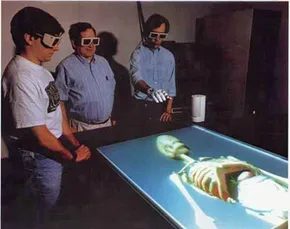
The workbench display have an awkward place in VR history. Some researchers believe that it simply does not relate to the real virtual environment. This is not a cave. It’s not a headset. This is something completely different.
In the early 1990s, Larry Rosenbaum led a team at the Office of Naval Research. They built a large monitor. It serves as a workspace. Users can view vertically. It can also be tilted horizontally to act as a table or bench. This setting allows multiple people to view the same screen at the same time.
Why Workbench is not a real virtual environment
Immersion is a key discussion here. The use of special glasses in front of the screen does not guarantee perfect sealing. The screen does not fill your field of vision. You are still aware of the physical space around you. Thanks to stereoscopic projections and shutter lenses, virtual objects can be seen in three dimensions. But when you take your eyes off the bench, you see the real world. There is no environment to explore. You are interacting with a digital object superimposed on reality.
“There is no virtual environment to explore. When the user looks away from the screen, they see a regular physical room.”
For some, the lack of full immersion is a mistake. For others, it’s a feature.
Medical training and military strategy
The practicality of the workbench display shines through cooperation. Consider medical training. Surgeons can practice operations on 3D virtual patients. They are surrounded by real medical staff. When wearing standard HMD, the staff becomes a computer-generated character or digital avatar. Workbench makes interaction with colleagues natural. It is completely real.
Military tacticians also benefit. Programmers create realistic 3D battlefield representations. Personnel get an accurate view the battle situation accurately. A good model can reveal potential bottlenecks. It shows hidden enemy encampments.
These uses extend beyond warfare and medicine. These displays can be seen in scientific research visualizations. They are also visible in product development. They form a bridge between data and human intuition.
Wii Controller: Cheap Gesture Interface
The story moves from passive observation to active control. Go to the next section on interactive devices. Specifically, Nintendo’s Wii.
The wireless wand controller offers a lesson for VR engineers. It is reasonably priced. It is easy to use. This device contains gyroscopes and accelerometer. These sensors detect motion. They detect tilt and rotation.
Compared to dedicated VR interface hardware, the Wii Remote is inexpensive. Some researchers are currently applying this to VR systems. Some see this as the first step in the trend. This trend points to low-cost user interface development.
VR outfit
Conversations move to the next level of immersion. We have looked at the monitors. We’ve already talked about controllers. The next logical step is what you wear outside your eyes and hands. The conversation turned to virtual reality clothing.
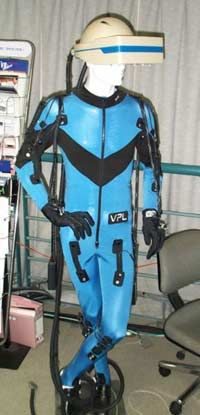
Aim for the easy and immersive feeling of VR
The graphics get all the credit. Because it’s easy to measure, we aim for higher frame rates and realistic textures. But researchers know that the real bottleneck isn’t what you see. This is how you touch it.
Basic controls break immersion. It feels like the keyboard is in the way. The joystick acts as an intermediary. You’re never really “in this world.” Sit on the chair and press the plastic. Is it ideal? There are no device at all. I want to forget I’m wearing anything.
Progress here is slow.
Why? Because there is not a lot of pressure from the big tech companies. Money flows into the graphics engine. Human-machine interfaces (HMI) are not urgent for the company. This is not a battlefield of giants. It’s a patchwork of entertainment studios, academic research institutions and small VR companies competing for traction.
But something is beginning to emerge.
The most promising development is wearable devices. It’s not headsets. gloves. body suit.
DataGloves: Fiber Optic Standard
Gloves have been part of the VR conversation since day one. Not by design. They are accidental finds. The early creators did not design them. But they worked.
People still commonly use the terms “DataGlove” or “Power Glove”. This is wrong. These are specific brand names. These are not synonyms for “VR hand tracker”.
Every glove has a purpose. Interact with digital objects using natural gestures. The methods are different.
Consider a fiber optic approach.
The light is transmitted from the transmitter to the sensor via a cable. Flex your fingers. The cable is bent. The light flow changes. When you make a fist, less light reaches the sensor. The CPU reads this. Converts light loss into virtual movement.
These are accurate. The official DataGlove uses this technology.
But there’s a problem. calibration.
Every hand is different. finger length. Flexibility. Skin tension. The gloves must be adjusted according to each user. Without it, the data is garbage. This is the sticking point. Barriers to entry.
Conductive ink: a cheaper option
Not everyone wants to calibrate a fiber optic system. Some want quantity. Some people are looking for affordability.
Add conductive ink.
These gloves use a strip of flexible material coated with a conductive material. Flex your fingers. The tape stretches. resistance changes. The CPU reads the change in resistance. Update the position of the virtual hand.
Make it simpler.
It’s not very accurate either.
Nuance is lost. A light squeeze can be seen as a clenched fist. Or vice versa. However, the cost difference is huge.
Fiber optic gloves are expensive devices. Conductive gloves are similar to consumer electronics.
Which is more important: accuracy or accessibility?
The industry is divided. State-of-the-art simulation requires precision. Mass market adoption has its price.
We are stuck in the middle. The gloves you wear are either too complicated or too stupid.
Until the hardware is completely gone.
The bodysuits. But different layer of skin. and various feedback.
Now our hands are wrapped in thread and ink. Try to feel the digital.
If you need precision, the dexterous hand master. These devices use sensors in each joint of the finger. It is connected to the skin by a mechanical connection. The result is an exoskeleton-style fit. Tracking is much more accurate than fiber optic gloves. It also outperforms conductive material sensors. But there are also compromises. These devices are heavy. They are clunky to wear. You sacrifice your comfort for data.
The unexpected legacy of the Power Glove
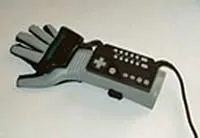
The Power Glove was created by a third party creator for the Nintendo Entertainment System. This is a consumer toy. VR researchers see potential in the hardware. They realized they could reuse the technology. It doesn’t have the versatility of the DataGlove. However, the costs are much lower. The device has a control plate on the forearm. This added input method proved useful. Since then, many other techniques have been introduced by system designers.
Why this hardware matters today
You might be wondering why vintage input devices are relevant now. These form the basis for movement tracking. The transition from conductive pads to joint sensors is changing the way we interact with virtual space. Modern controllers still rely on these early principles. The design of the exoskeleton later influenced haptic feedback systems.
Compare input methods
Which gloves should you choose?
–Dexterous Hand Masters : Excellent accuracy. Due to the weight, it is not suitable for long sessions.
– Conductive Gloves : cheap. Not very accurate. Installation is now easier.
– Fiber Optic Glove : Medium accuracy. The wiring is bulky.
– Power Glove Adaptations : Affordable. Good for recognizing basic gestures.
VR designers continue to iterate on these concepts. The goal remains the same. Capture human movement without sacrificing immersion.
“This glove isn’t as versatile as the DataGlove, but it’s a lot cheaper and comes with a forearm trackpad.”
Here’s a look at other VR input devices that followed these early efforts.
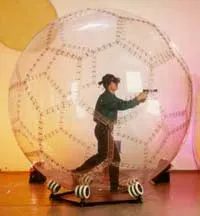
If you want to move around in VR, skip the CAVE and the expensive DataSuit. No need for a joystick or stick. Researchers believe that natural movement can improve immersion. Engineers have built several systems to achieve this goal.
Treadmill and full body workout
A treadmill allows you to feel as if you are walking in a virtual environment while remaining stationary in the real world. Connecting the treadmill to the computer is easy. The steps adjust the graph. There is a catch. On a regular treadmill, you can only move forward or backward.
Several companies make omni-directional treadmills. They allow you to move in any direction. A standard treadmill uses one motor. Push forward or backward. Omnidirectional models have two motors. It can be pushed in four directions: forward, backward, left and right. Both motors work together. You walk on a surface wrapped around belts and cables.
Pressure pad and ball system
A pressure pad is also an option. You might know them from “Dance Dance Revolution.” Most use electromechanical pressure sensors. These relays are activated when pressurized. The circuit is closed. Electric current flows. The CPU changes the graphics.
VirtuSphere, Inc. offers a different approach. It looks like a human-sized hamster ball. You go in and walk. The ball is placed on a stable base with wheels. The wheels press against the sphere. This way you can roll in any direction while staying still. The sensors on your wheels tell the CPU which direction you are walking. The headset view changes accordingly.
Immersive passive haptics
CAVE researchers are testing passive touch. Haptic refers to the sense of touch. Haptic systems provide physical feedback. A force-feedback joystick is an active example. Passive touch does not apply force. Use real objects to represent virtual elements. A real folding table acts as a virtual kitchen counter. Touching the real thing adds to the sense of immersion. Helps to navigate the simulation.
In the next section, we present the HMD and DataGloves tracking systems. First look at the string walker.
String Walker device
StringWalker was developed by a Japanese company. It is a unique multi-directional treadmill. The device is ring-shaped. Eight threads cross the diameter. You walk on the strings. This conference focuses on computer graphics and interactive devices.
Virtual reality tracking system
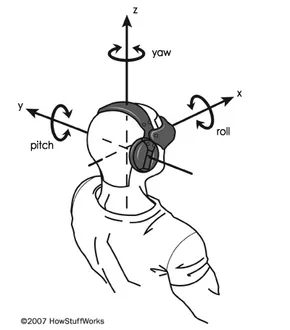
Tracking devices are the backbone of any functioning VR system. They don’t just sit there. They communicate with the processing unit and tell it exactly where your head is in space. If you can walk around the room in VR, the tracker knows your location, direction and speed. Without them, the illusion crumbles quickly.
Most systems focus on one standard: six degrees of freedom (6-DOF). This is the Holy Grail of immersion. Track position on the X, Y, and Z axes. It also tracks direction, divided into yaw, pitch and roll.
From your point of view, this means that the virtual world moves with you. look up? The view shifts down. Do you tilt your head? The horizon tilts. Move forward without looking up? You get closer to the virtual objects. The headset sensor tells the CPU where you are. The CPU will render the correct image. The screen will be updated. It happens so fast that you don’t even notice the gap.
How the signaling system communicates
Each tracking setup shares three components. A transmitter generates a signal. The sensor recognizes it. The control unit processes data for the CPU. Arrangements vary.
Sometimes you wear the sensors. The transmitter is fixed indoors. Other times, you wear the emitters. Sensors installed on the walls and ceiling record your movements. The hardware flips. The logic remains.
The signals themselves are very different. Electromagnetic, acoustic, optical and mechanical options are available. Each has advantages and disadvantages.
Electromagnetic tracking system
These systems measure magnetic fields. It works by directing electric current through three perpendicularly arranged coils. Each coil becomes an electromagnet. Sensors measure how these fields interact. This interaction reveals the orientation and orientation of the emitter.
“A good electromagnetic tracking system is very sensitive and has low latency.”
Low latency is a big advantage. The downside? Anything that generates a magnetic field can interfere with the signal. Metal desks. Other electronics. Even the frame of the building can distort the data.
Acoustic tracking system
Acoustic trackers use ultrasound. position and orientation are determined by measuring the time it takes for the sound waves to reach the sensor. The sensor is usually left in place. You wear the emitters.
The calculation is easy. Distance is speed x time. But the sound is very slow. Updates lag behind the actual movement. This is not suitable for fast-paced VR.
Environment kills acoustic tracking too. Changes in temperature. humidity. Air pressure. All of this changes the speed at which sound travels through the air. If your data is inconsistent, your tracking will be unstable and unreliable.
Optical tracking device
Optical systems use light. Typically, an infrared LED is used as the emitter. The camera acts as a sensor. The LEDs flash in sequence. The camera records light patterns. The processing unit infers the location and direction from these pulses.
Optical tracking boasts a fast upload rate. Delays are minimal. For this reason, most modern high-end VRs use optical or hybrid opto-mechanical methods.
But line-of-sight is a vulnerability. Cover the camera with your hand. Put a plant in front of the sensor. Tracking breaks. Ambient light and other infrared sources can also wash out the signal. A controlled environment is required for best results.
Mechanical Tracking Systems
Mechanical tracking is an old-fashioned method. It uses a physical connection. The target is tethered to a fixed point.
Think of a BOOM display. This is a head-mounted display attached to a robotic arm with two points of articulation. The arm detects position and orientation directly. No wireless signals to decode. No sound waves to time. No light to track.
The update rate is incredibly high. It’s precise. However, it limits your range of motion. You’re physically tied to the setup. You cannot walk across the room. You are an island of steel and hinges.
Modern virtual reality has gone far beyond room-level experiences with purely mechanical systems. But the principle remains the same. Physical constraints guarantee accuracy, but at the expense of freedom.
We’re moving toward wireless, room-scale freedom. But the trade-off remains. Speed vs. accuracy. Freedom vs. precision. Wireless convenience vs. interference.
The following pages discuss the specific devices that enable these systems. Until then, think about what you are willing to sacrifice for immersion.